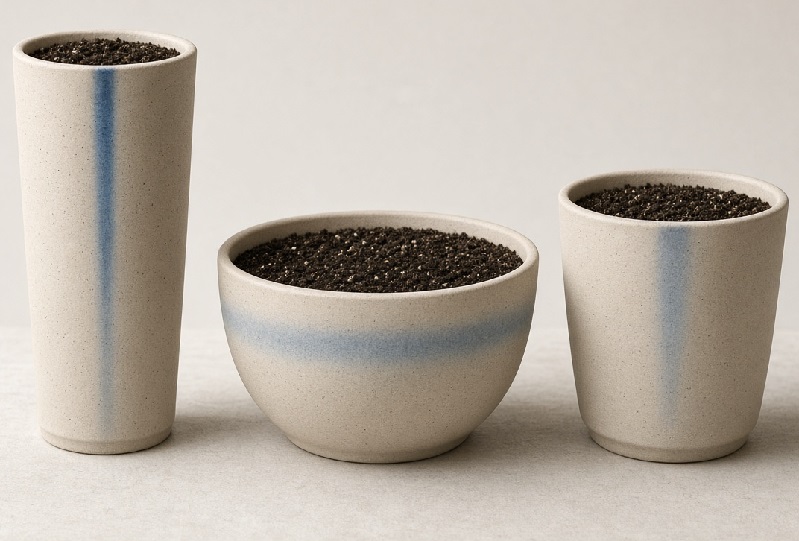
Two pots filled with the same potting mix can behave differently after watering, even when they hold roughly the same volume of soil. A tall, narrow container may drain more freely and leave more air around the roots, while a short, wide container can retain a larger proportion of water after drainage.
The difference isn’t caused by the soil suddenly changing its properties. It comes from what happens when the same pore structure is placed inside containers of different heights.
Virginia Tech’s current houseplant guidance says container height has a strong effect on drainage: taller containers drain more, while shorter containers leave a greater share of their pore spaces filled with water. Iowa State describes the same effect using a saturated zone at the bottom of the pot.
Understanding that relationship helps explain several situations that can otherwise seem contradictory, including why a shallow pot may have a dry-looking surface while the lower root zone remains wet.
The Same Potting Mix Isn’t Equally Wet From Top to Bottom
After a pot is watered thoroughly and excess water has finished draining, moisture isn’t distributed evenly through the container.
The lower part of the pot remains wetter because water is held in the smaller pores against gravity. Higher in the container, gravity has pulled more water from the larger pores, leaving them filled with air instead.
Iowa State refers to the wetter lower portion as a saturation zone. With the same potting mix, that zone tends to reach roughly the same height whether the container itself is short or tall. What changes is how much soil sits above it.
Imagine that a particular mix develops a wetter bottom zone roughly two inches deep after watering. In a four-inch-tall pot, that zone occupies a large part of the root space. Put the same mix into an eight-inch-tall pot and there is much more comparatively aerated soil above it.
The soil recipe hasn’t changed, but the root environment has.
Also Read:
A Short, Wide Pot Can Hold a Higher Proportion of Water
This is the part that often surprises people.
Shallow pots look as though they should drain especially well because there isn’t much soil for water to travel through. In terms of the percentage of water left in the mix after drainage, the opposite can happen.
UC Agriculture and Natural Resources explains that, for a given potting mix, water-holding capacity increases as container height decreases, while air-filled porosity falls. Their examples show much less air space in shallow cells than in taller pots filled with the same type of medium.
Iowa State makes the same point: shallow containers can be harder to manage for plants that dislike wet roots because a larger proportion of their root zone sits within the wetter lower layer.
This doesn’t mean every wide bowl will remain wet longer than every tall pot in a real home. Surface evaporation, container material, plant size, root density, light, temperature, and total soil volume still affect how quickly the pot dries over subsequent days.
The shape changes the starting water-to-air balance after drainage.
Height Matters More Than Width for Drainage
When people compare pot shapes, they often focus on diameter. For drainage behavior, height deserves more attention.
Virginia Tech states that taller containers drain more than shorter ones and that container width itself does not determine drainage in the same way.
Consider two containers holding a similar amount of potting mix:
- one is tall and narrow
- the other is broad and shallow
The shallow container has less vertical distance between the soil surface and the bottom drainage point. A larger share of its mix therefore sits in the wetter region near the base.
The taller pot provides a longer column of substrate above that region, where more of the large pores can empty and refill with air.
This is one reason nursery and greenhouse growers pay attention not only to substrate recipes but also to the containers in which those substrates will be used. Cornell’s greenhouse growing-media material notes that container height can markedly change the air-to-water relationship even when the media itself remains the same.
Think of a Wet Sponge Turned in Different Directions
A sponge gives a useful physical demonstration.
Saturate a rectangular sponge with water and hold it flat until it stops dripping. Then turn it onto its narrow edge. More water comes out. Stand it upright and additional water may drain again.
Nothing about the sponge changed. Its pores are the same size and the sponge contains the same material, but increasing its vertical height allows gravity to remove more water.
UC ANR and Cornell both use versions of this demonstration when explaining container-media physics.
Potting mix behaves in a more complicated way than a kitchen sponge, but the comparison makes the effect of container height easier to picture.
A Wide Surface Creates a Different Drying Pattern
Drainage immediately after watering is only part of the story. Once the pot has stopped dripping, water continues disappearing through evaporation from the soil surface and transpiration through the plant.
A broad, shallow container exposes more soil surface than a narrow container holding a similar volume of mix. That larger exposed area can increase surface evaporation under otherwise similar conditions.
Research published in Water Resources Research found that container geometry and exposed surface area changed evaporation behavior in sand and sandy loam. The exact results depended on both container shape and the material being tested, which is a useful reminder that shape and substrate interact rather than operating independently.
For a planted houseplant pot, transpiration through the foliage can account for a large share of water use, so exposed soil area doesn’t determine drying time by itself. Virginia Tech notes that surface evaporation occurs mainly from the upper layer of substrate, while plant transpiration is a major route of water loss from planted containers.
This creates an interesting possibility: a wide shallow pot can look dry at the surface relatively quickly while still holding considerable moisture lower down.
A Dry Surface Doesn’t Prove the Whole Pot Is Dry
Wide containers make surface checks particularly easy to misread.
More soil is exposed to moving indoor air, sunlight, and low humidity, so the upper layer may lose moisture quickly. Push deeper into the pot, however, and the mix near the bottom can still be quite wet.
That is one reason watering every time the surface changes color can gradually keep the lower root zone wetter than intended.
The problem becomes more noticeable with fine, moisture-retentive potting mixes. Smaller pores hold water more strongly, and Iowa State notes that the height of the wetter lower zone depends partly on the pore sizes within the mix.
For a broad planter, check moisture below the surface rather than using the top half-inch as the only signal.
A Tall Pot Can Have a Wetter Bottom and a Drier Top at the Same Time
A tall container doesn’t become uniformly dry simply because it drains more.
Moisture still tends to increase toward the bottom. The difference is that a taller pot has more substrate above that wetter section, creating a stronger vertical moisture gradient.
Research by USDA and Oregon State scientists found that increasing container height reduced container water-holding capacity and increased air space in Douglas-fir bark substrates. Moisture also varied by depth within the container rather than remaining uniform from top to bottom.
For houseplants, this can matter when roots occupy different depths. Surface roots may experience a comparatively dry environment while roots near the base remain in wetter mix.
Checking only one point in a deep pot can therefore give an incomplete picture.
Pot Volume Still Matters
Shape shouldn’t be confused with size.
A tiny tall pot can dry faster than a huge shallow planter because the small container simply stores much less total water. Virginia Tech notes that small containers generally dry faster than larger ones because they contain a smaller reservoir of potting mix and moisture.
So there are two separate effects to think about.
Container height influences the proportion of water and air left in the substrate after drainage.
Container volume influences how much water the pot can store in total.
A one-liter tall pot and a one-liter shallow pot let you see the shape effect fairly clearly. Compare a one-liter pot with a ten-liter planter and total volume begins dominating the comparison.
Pot Material Can Hide the Shape Effect
Two containers with the same dimensions can still dry at different rates if their materials aren’t alike.
Plastic and glazed ceramic are largely nonporous, so most moisture leaves through the soil surface, drainage openings, and the plant itself. Unglazed terracotta also allows water to evaporate through the container walls.
Virginia Tech notes that terracotta tends to dry the root zone faster than nonporous containers regardless of the potting mix used.
A shallow terracotta bowl may therefore dry faster in everyday use than a deeper plastic pot, even though the shallow geometry itself promotes a higher proportion of water after drainage.
That isn’t a contradiction. Different processes are occurring at different stages.
Container height affects drainage and water distribution immediately after watering, while wall porosity influences how quickly moisture is lost afterward.
Why Shallow Pots Aren’t Automatically Better for Succulents
Succulents are often placed in shallow bowls, which can make it seem as though shallow pots naturally provide better drainage.
The physics doesn’t support that as a general rule.
With the same potting mix, a shallow container retains a greater proportion of water and has less air-filled pore space than a taller one. Iowa State specifically notes that crops needing very good drainage are often grown commercially in taller containers or in substrates adjusted to contain more large air-filled pores.
A shallow succulent bowl can still work very well because other parts of the setup compensate for its shape. The mix may contain coarse mineral particles, the container may be relatively small, the plant may receive strong light, or the pot may be made from porous terracotta.
Using an extremely fine, water-retentive mix in the same shallow bowl would create a very different root environment.
Pot Shape and Soil Mix Have to Be Considered Together
There isn’t a universally good pot shape because container geometry and substrate structure interact.
A fine mix containing a lot of peat or coir has many smaller pores that retain water well. Put that mix in a very shallow container and the already moist substrate may contain even less air after watering.
A coarse bark-and-perlite mixture behaves differently because more of its pore space drains readily. UC ANR notes that shallow propagation containers are often paired with mixes containing larger particles precisely to improve air-filled porosity.
The container cannot be evaluated separately from what is inside it.
A pot that works well with one mix may become frustrating with another.
The Same Pot Can Behave Differently After Repotting
This also explains why changing pot shape can alter watering frequency even if you reuse the same type of soil.
Suppose a plant moves from a tall nursery pot into a wide decorative bowl containing roughly the same volume of mix. The new root zone may retain a higher proportion of water after drainage because the soil column is shallower.
Continuing the old watering interval could then keep the plant wetter than expected.
The reverse can happen after moving from a shallow pot into a taller container. More water may drain from the same type of substrate, leaving greater air space and potentially shortening the period during which some parts of the root zone remain moist.
After changing container shape, relearn how the pot dries rather than assuming the previous schedule still applies.
What Different Pot Shapes Usually Mean for Watering
| Pot shape | What tends to happen |
|---|---|
| Tall and narrow | Greater drainage through the substrate column and more air-filled space after watering |
| Short and wide | Greater proportion of the mix remains water-filled after drainage |
| Wide with a large exposed surface | Surface may dry relatively quickly through evaporation |
| Very deep pot | Stronger difference between the drier upper mix and wetter lower mix |
| Small pot of any shape | Lower total water storage and often faster overall drying |
| Large pot of any shape | More total stored water and potentially longer intervals between watering |
These are tendencies rather than watering instructions. Plant size, root density, pot material, light, humidity, temperature, soil composition, and drainage openings still affect what happens in an actual room.
Choosing a Pot by Shape Rather Than Appearance Alone
Pot shape is worth considering whenever a plant has strong preferences around root moisture.
A plant that dislikes prolonged wetness may be easier to manage in a somewhat taller container paired with an airy potting mix. A moisture-loving plant may tolerate a shallower container more comfortably, although good drainage still matters.
Root shape matters as well. Some plants naturally make deeper root systems, while others spread more horizontally, so moisture physics shouldn’t be the only reason for choosing a container.
The useful lesson is that potting mix doesn’t have one fixed water-retention behavior independent of the container. Put the same mix into a tall pot and a shallow pot, and gravity creates different proportions of water and air after drainage. Add surface area, pot material, plant roots, and evaporation, and those two containers can develop noticeably different watering rhythms even though the soil recipe on the bag was identical.
That is why changing the pot can change watering behavior without changing the soil at all.