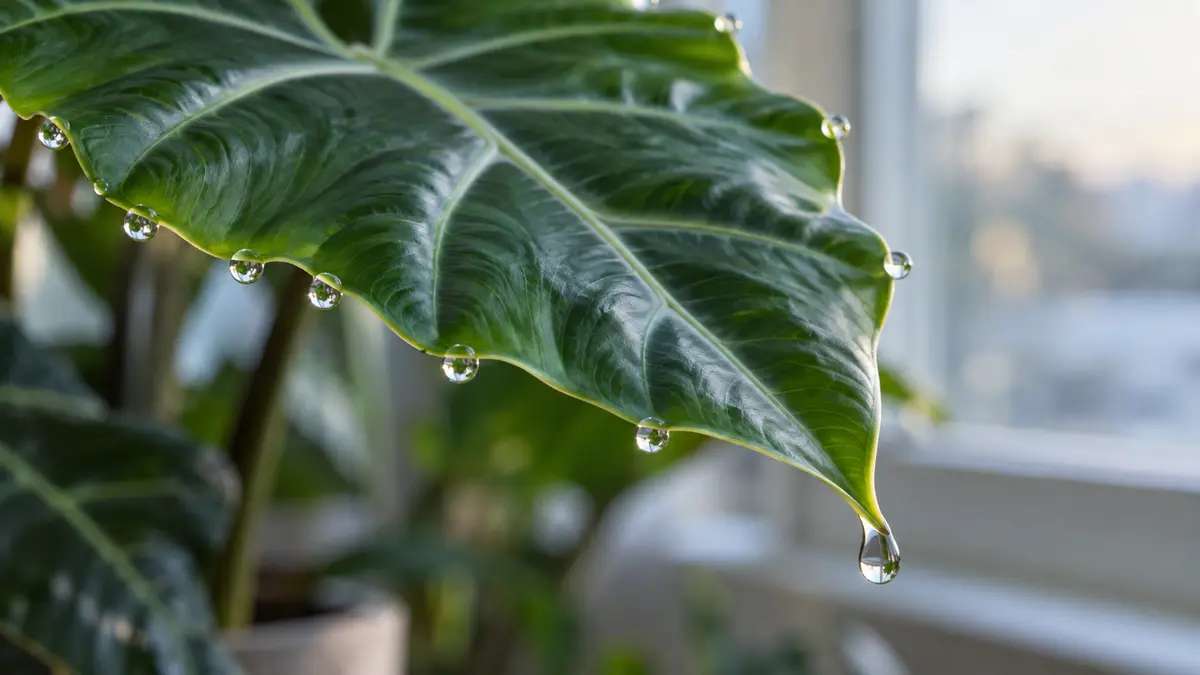
A clear drop hanging from the point of a houseplant leaf can look like a leaking pipe in miniature. It often appears in the morning, sometimes after the plant was watered the previous evening. The leaf above it looks healthy, there is no obvious spill, and another bead may be forming along the margin.
That drop may be guttation: liquid pushed out through specialized structures at the ends of leaf veins. It may also be ordinary condensation, irrigation water, or sticky honeydew left by sap-feeding insects. The location, timing and feel of the liquid usually separate these possibilities without guesswork.
The Quick Difference: Guttation, Dew or Honeydew?
| Clue | Guttation | Dew or condensation | Pest honeydew |
|---|---|---|---|
| Where it appears | At leaf tips or along margins, often near vein endings | Across exposed leaf surfaces and nearby cool objects | Scattered on leaves, stems, shelves or foliage below insects |
| Typical timing | Night or early morning, often when the root zone is moist | When a surface cools enough for airborne moisture to condense | Any time sap-feeding pests are active |
| Texture | Usually watery when fresh; may leave a light mineral mark | Plain water and not sticky | Shiny and noticeably sticky |
| What else to look for | A healthy leaf and droplets repeatedly forming at the same edges | Moisture on windows, pots or multiple exposed surfaces | Scale bumps, mealybugs, aphids, ants, cast skins or sooty growth |
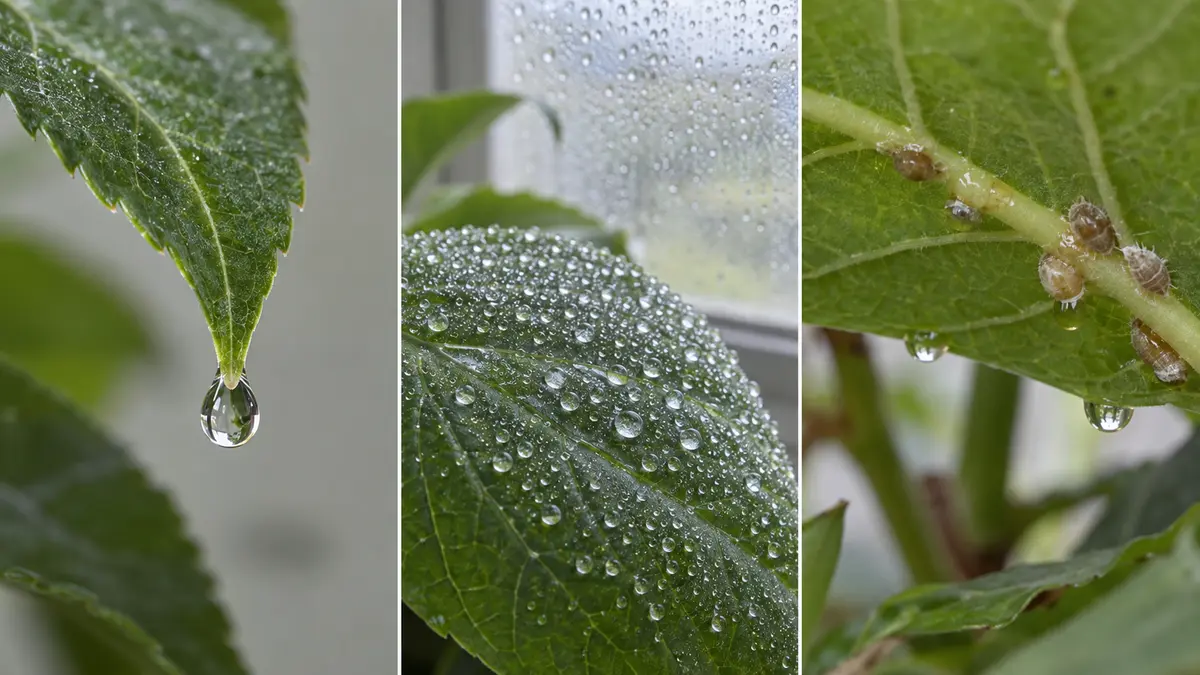
Do not diagnose from one clue alone. A drop at a leaf tip strongly suggests guttation, but stickiness or visible insects changes the answer. A wet leaf just after misting tells you little until that added water has dried.
What Guttation Actually Is
Plants move water through xylem, the vascular tissue that carries water and dissolved materials from the roots toward the shoots. During the day, evaporation from leaves—transpiration—helps pull water upward. At night, transpiration often falls because stomata are less open and the surrounding air may be cooler or more humid.
If roots continue taking up water while loss through the leaves is low, pressure can develop in the xylem. That root pressure can push liquid out through hydathodes, specialized structures commonly located at leaf tips or margins near the ends of veins. The visible release of that liquid is guttation.
Guttation is therefore not the same as a plant “sweating” through its entire surface. It is a liquid-phase release from particular exit points. Peer-reviewed anatomical work on hydathodes describes the process as passive water movement driven by root pressure. The University of Missouri similarly explains that positive root pressure pushes xylem contents through hydathodes when conditions favor the process.
Why the Drops Often Appear Overnight
Guttation is easiest to notice when the soil contains available water and the atmosphere is not drawing much moisture from the leaf. Those conditions commonly overlap at night: the plant was recently watered, air temperature falls, relative humidity rises and transpiration slows.
The root system does not simply switch off the moment the room becomes dark. Dissolved ions in root cells and xylem influence water movement, and positive pressure can build when water entering the root system is not being lost rapidly from the canopy. Liquid then finds its way to hydathodes at the ends of the vascular network.
By midmorning, the droplets may have fallen or evaporated. Light, warmer air and lower relative humidity can increase evaporative demand, shifting water loss back toward transpiration through stomata. That is why someone who only checks plants in the afternoon may never see guttation at all.
Why the Drop Forms at a Tip or Edge
Location is one of the best diagnostic clues. Hydathodes are associated with vein endings, and many leaves concentrate those endings near their margins or at a pointed tip. Liquid emerges there and gathers into a bead large enough to hang, roll down the blade or fall onto the floor.
Aroids and other broad-leaved tropical houseplants can make the effect especially obvious because a large drop can collect at a pointed leaf tip. You may notice it on Alocasia, Philodendron, Monstera or pothos, but guttation is not restricted to those groups. It occurs across many kinds of vascular plants, including grasses and numerous outdoor species.
Species, leaf structure, root activity and room conditions all affect how visible it becomes. Two plants watered at the same time may not produce equally obvious drops, and the absence of guttation does not mean that a plant has failed to take up water.
Guttation Is Not Dew
Dew begins outside the plant. When a surface becomes cool enough, water vapor from the surrounding air condenses on it. Droplets can form across the upper leaf surface, on the pot, on a nearby window or on other objects exposed to the same cool, humid air.
Guttation begins inside the plant. Water travels through the root and xylem before emerging at hydathodes. Its arrangement is therefore more anatomical: beads tend to line up at tips or along the margin rather than coat every exposed surface evenly.
Context settles many ambiguous cases. If several objects beside the plant are damp after a cool night, condensation is likely. If a healthy leaf repeatedly develops one drop at the same pointed end while the surrounding shelf remains dry, guttation is more likely. Both can occur on the same morning, so the answer does not always have to be one or the other.
Guttation Is Not Transpiration Either
Transpiration is mainly the loss of water vapor from leaves, much of it through stomata. You normally cannot see an individual plant’s transpired water as droplets leaving those pores. Guttation releases liquid water through hydathodes, which is why it can make a visible bead.
The distinction matters because the two processes become prominent under different atmospheric conditions. Strong evaporative demand supports transpiration. Guttation is favored when root pressure is present but evaporative loss is low. PlantClinic’s guide to vapor pressure deficit and relative humidity explains how temperature and humidity together change the drying power of air around a leaf.
A nighttime guttation drop does not show that the plant was transpiring heavily. In fact, it often becomes visible precisely because ordinary evaporative loss has slowed.
The Sticky-Drop Test for Honeydew
Honeydew is a different warning. Aphids, soft scale, mealybugs and whiteflies feed on plant sap and can excrete a shiny, sugar-rich liquid. It may land on the leaf where the insects are feeding, on lower leaves, or on the shelf beneath the plant. Unlike fresh guttation or dew, honeydew feels sticky after a careful touch.
If the drop is sticky, inspect the plant before assuming it is harmless. Look beneath leaves and along midveins, petioles, stem joints and tender new growth. Soft scale can resemble small brown or tan bumps attached to the plant. Mealybugs often look like white cottony clusters. Aphids may gather around new leaves or buds, while whiteflies can flutter up when foliage is disturbed.
University of Minnesota Extension identifies shiny, sticky honeydew as a detection clue for several indoor-plant pests. Ant activity and dark sooty growth can also occur around sugary deposits. Isolate a suspicious plant while you inspect the rest of the collection, and identify the pest before choosing a treatment. Guttation does not create insect bodies, cast skins or expanding colonies.
Does Guttation Mean You Overwatered?
Not by itself. Guttation shows that water was available to the roots, root pressure developed and conditions allowed liquid to leave through hydathodes. A recently watered, healthy plant can guttate even when its watering routine is appropriate.
The condition of the potting mix matters more than the droplet alone. Check how long the center of the root ball stays wet, whether the pot drains, and whether the plant shows yellowing, wilting in damp mix, soft stems or a sour smell. Frequent drops combined with a root ball that never approaches the plant’s normal watering point deserve attention. Drops on an otherwise vigorous plant in a freely draining pot may require no correction.
Do not respond by skipping water for an arbitrary number of days. A small pot in bright light and a large pot in a cool corner can have very different drying times. Use pot weight, a skewer or a finger check at useful depth, and the plant’s recent trend. The PlantClinic watering guide describes why the interval changes with season, light and root activity.
If the plant is wilting while the mix remains wet or the roots smell and feel soft, investigate root rot and poor aeration. Guttation alone is not a root-rot diagnosis, but it should not distract you from stronger evidence in the pot.
Why a White Mark Can Remain After the Drop Dries
Guttation fluid is not necessarily chemically identical to distilled water. It has traveled through plant tissues and can contain dissolved ions and other compounds. When the water portion evaporates, a pale outline or tiny crust can remain at the edge of the leaf.
One isolated residue exactly where a droplet dried is not the typical pattern of powdery mildew. It should wipe away with a soft damp cloth. Mildew tends to produce spreading patches on leaf surfaces rather than a neat deposit at a repeated drip point.
Persistent heavy residue may justify looking at both fertilizer use and irrigation water. Do not infer a specific mineral from color alone. The chemistry of a water source cannot be diagnosed by looking at a white spot, and the pH number by itself does not reveal total dissolved salts or alkalinity. PlantClinic’s article on water pH, alkalinity and root-zone change provides the useful distinctions.
Should You Wipe the Drops Away?
You can. Blotting a drop with a clean soft cloth prevents it from landing on furniture and removes dissolved residue after it dries. Support the leaf rather than bending its petiole, and avoid rubbing delicate new growth.
There is no need to squeeze the leaf, press the tip or seal the hydathode. Guttation is a normal plant process. Damaging the tip creates a wound and does not correct the conditions driving root pressure.
If the plant was recently treated with a systemic or foliar pesticide, keep droplets away from children and animals and follow the product label’s precautions. Even on an untreated plant, there is no reason to taste or deliberately consume the fluid. Wipe the shelf, wash your hands after handling treated plants and place the pot where falling droplets will not damage a porous surface.
A Three-Minute Droplet Check
- Look at the position. A bead emerging from a tip or regular points along the margin fits guttation. Moisture spread across everything fits condensation or recent misting.
- Check the feel carefully. Watery liquid suggests guttation or dew; shiny stickiness raises suspicion for honeydew. Wash your hands afterward, particularly if pesticides have been used.
- Inspect the plant. Turn over leaves and check veins, petioles and new growth for scale, mealybugs, aphids or whiteflies.
- Check the root zone. Note the moisture at depth, drainage, pot weight and how many days the mix has remained wet.
- Watch the pattern. Photograph the leaf and check again the next morning. Repeated edge droplets under similar conditions are more informative than one unexplained splash.
This short check is usually enough to decide whether you are seeing a normal physiological event, moisture from the room, or a pest signal that needs action.
When the Dripping Deserves More Attention
Guttation itself is generally not an emergency. The surrounding evidence can be. Investigate further when the pot remains saturated for an unusually long time, leaves are progressively yellowing, the plant wilts in wet mix, stems become soft, or an unpleasant odor comes from the root ball. Those are root-zone signs, not consequences proven by the droplet.
Act promptly when the liquid is sticky and insects or scale-like bumps are present. Also move a dripping plant away from unfinished wood, electronics and fabrics that could be marked by repeated drops. A saucer protects the area below the pot but will not catch liquid falling from a leaf that extends beyond it.
Otherwise, treat guttation as useful information. It tells you that the plant had access to water and that its nighttime water balance favored root pressure over evaporation. Check the soil, protect the surface and let the next watering be decided by the root ball—not by the presence or absence of one photogenic drop.
Frequently Asked Questions
Why does my Monstera or Alocasia drip after watering?
A recently moist root zone combined with low nighttime transpiration can create root pressure. Liquid may then exit through hydathodes near the leaf margins or pointed tips. This is guttation and can occur on a healthy plant, but you should still make sure the pot drains and the mix is not staying saturated unusually long.
Is guttation harmful to houseplants?
The process itself is generally normal. It becomes a reason to inspect care when it occurs alongside stronger trouble signs such as persistently wet mix, yellowing, wilting, soft roots or stem tissue. Those symptoms matter more than the drop.
How can I tell guttation from a pest problem?
Guttation is usually watery and positioned at leaf tips or margins. Honeydew from pests is shiny and sticky and may appear on stems, lower leaves or the surface beneath the plant. Look closely for aphids, soft scale, mealybugs, whiteflies, cast skins and sooty growth.
Why does guttation leave white spots?
Dissolved material can remain after the water in a guttation drop evaporates. Wipe it gently with a damp cloth. A small residue at a drip point is different from a spreading fungal coating, although any expanding or recurring surface growth should be inspected separately.
Should I stop watering a plant that guttates?
Do not stop on the basis of guttation alone. Check moisture at depth and learn how long that pot normally takes to reach its watering point. Delay the next watering if the root ball is still wetter than the species needs, but do not impose a fixed dry period regardless of the plant’s condition.
Sources
- University of Missouri Integrated Pest Management: Guttation—A Pressure Relief for Plants
- PLOS ONE via PubMed Central: Anatomy of leaf apical hydathodes in four monocotyledon plants
- University of Minnesota Extension: Managing insects on indoor plants
- University of Minnesota Extension: Aphids in home yards and gardens