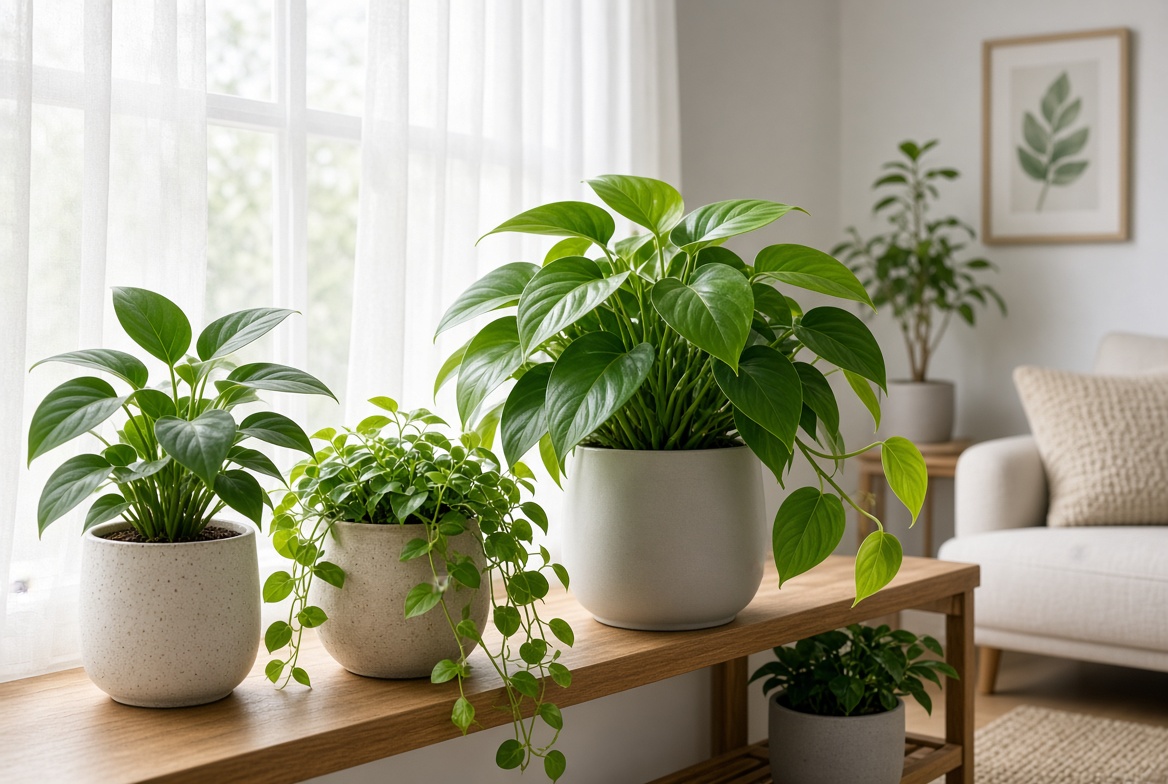
“Bright indirect light” appears on plant labels so often that it sounds like it should be obvious. In a real home, it rarely is. A plant can sit near a sunny window and get direct sun for part of the day, then spend the rest of the afternoon in indirect light. Move it farther into the room and the sun may never touch its leaves, yet the spot may still be too dim for healthy growth.
Indirect light means sunlight reaches the area around a plant without a strong, unobstructed beam falling directly on the foliage. The light may be scattered by a curtain, reflected around the room, softened by trees outside, or simply reaching the plant from an angle that keeps it out of the sunbeam.
The word indirect only describes how the light reaches the plant. It doesn’t tell you how much light is there. Indirect light near a large window can be very bright, while indirect light at the back of the same room may be weak enough to slow growth.
That distinction makes houseplant lighting much easier to understand.
Indirect Light Doesn’t Mean a Dark Corner
One of the more confusing parts of plant care is that “indirect light” sometimes gets interpreted as “keep this plant away from the window.” That can put a plant in far less light than it actually needs.
Imagine a Monstera sitting two feet to the side of a large east-facing window. No direct sun reaches the leaves, but the plant is surrounded by strong daylight for much of the morning. Now move that same plant eight feet into the room. It still isn’t getting direct sun, so the light is technically indirect, but the intensity has dropped a lot.
Plants notice that difference more than we do. Human eyes adjust quickly as we move between bright and dim spaces, which makes indoor rooms look more evenly lit than they really are. A corner that seems comfortably bright to us can be quite dark from a plant’s point of view.
So a room being “bright” doesn’t tell you enough. What matters is the light reaching the leaves where the pot actually sits.
Direct Sun and Indirect Light Can Exist in the Same Spot
A plant’s light exposure can change several times during the day.
If sunlight passes through clear glass and creates a bright beam across the leaves, the plant is receiving direct light. Window glass doesn’t automatically turn sunlight into indirect light. A plant sitting directly in a sunny windowsill can still get strong direct exposure even though the sun is coming through glass.
Indirect light starts once the foliage is outside that beam, or when something scatters the sunlight before it reaches the plant. A sheer curtain can soften direct sun. Tree branches outside can break it into shifting patches. Blinds, neighboring buildings, balconies, roof overhangs, and even the position of the plant beside the window can change what finally reaches the leaves.
This is why it makes more sense to watch the plant’s actual position than to label an entire room as direct or indirect light.
The Shadow Test Gives You a Quick Clue
You don’t need equipment to get a rough idea of what kind of light a plant is receiving. A simple shadow check can tell you quite a bit.
Hold your hand between the window and the surface beside the plant during the brighter part of the day. A dark shadow with sharp edges usually points to stronger light and may mean direct sun is reaching that location. A softer but still visible shadow often fits bright indirect conditions. If the shadow is weak or barely visible, the area is likely much dimmer.
The test isn’t exact, and it shouldn’t be treated like a measurement. Clouds move, sun angles change, and the result at 10 in the morning can look completely different at 4 in the afternoon.
Checking the same spot more than once tells you more than a single glance. An east-facing window may produce direct sun early and indirect light later. A west-facing room can behave almost the opposite way, staying fairly mild through the morning before stronger afternoon sunlight begins reaching the plants.
Window Direction Helps, but It Doesn’t Decide Everything
Two plants can sit in rooms of similar size and receive very different amounts of light because their windows face different directions.
In the Northern Hemisphere, south-facing windows usually receive longer periods of sunlight. East-facing windows get morning sun, while west-facing windows pick up later-day light that can become quite strong during warm months. North-facing windows tend to receive less direct sun and often provide gentler conditions.
The pattern reverses between north and south in the Southern Hemisphere, but direction is still only part of the story. A south-facing window looking straight into a neighboring building may provide less usable light than a clear east-facing window with open sky outside.
Trees matter too. A mature deciduous tree can shade a room through summer and then drop its leaves in autumn, allowing much more sun to enter. Deep roof eaves, balconies, screens, curtains, and dirty glass can all reduce what reaches the plant. Window direction gives you a starting point, not a guarantee.
East-Facing Windows Often Give Plants an Easier Start
Morning sunlight is usually less harsh than strong late-afternoon exposure, which is why east-facing rooms work well for many foliage plants.
A plant sitting right on the windowsill may receive some direct sun after sunrise. Move it slightly to the side or a little farther back, and you can often keep much of that brightness without leaving the foliage in the direct beam for long.
This can suit plants such as philodendrons, Monsteras, Pileas, and many Peperomias. They often grow better with plenty of daylight than they do in a dim interior position, even when their labels warn against strong direct sun.
Still, not every east window behaves the same way. A large unobstructed window can admit much more light than a small window partly blocked by trees or another building.
South-Facing Windows Can Give You More Options Than the Sill
A large south-facing window can brighten a good portion of a room. The sill itself may be too exposed for plants with delicate foliage during summer, but that doesn’t mean the whole side of the room is unsuitable.
Moving a plant back from the glass often keeps it in a bright area while reducing direct exposure. Placing it just beside the window can work too. A sheer curtain may soften the sun enough for plants that scorch under stronger beams.
Winter changes things. Days become shorter, the sun sits lower, and the same window may become far gentler than it was in midsummer. A plant that needed protection from the glass in July might benefit from being moved closer in January.
Indoor placement isn’t always permanent. Sometimes the best spot changes with the season.
West-Facing Windows Can Surprise You Later in the Day
West-facing rooms can be misleading because they may look mild for hours before stronger sunlight arrives in the afternoon.
A plant may sit in soft light through the morning and then receive two or three hours of direct sun later. If someone only checks the room before work, they may never see that stronger exposure.
This can explain leaf scorch that seems to appear for no clear reason. The plant wasn’t suddenly sensitive. Its owner simply wasn’t around when the strongest sun reached it.
Watching the room at different times of day gives you a much better idea of what the plant actually experiences.
North-Facing Doesn’t Automatically Mean Too Dark
North-facing windows are often described as low-light windows in the Northern Hemisphere, but that description can be too broad.
The area close to a large, unobstructed north-facing window may still support plenty of foliage plants. Pothos, Chinese evergreens, snake plants, some philodendrons, and other plants that tolerate lower light can do reasonably well there.
Move several feet away from the window and conditions change quickly. A plant near the glass and another at the back of the room may both be receiving indirect light, but they aren’t receiving the same amount.
That difference becomes more noticeable during winter, when already modest daylight becomes weaker and shorter.
There Is No Fixed Distance for Bright Indirect Light
Advice such as “keep the plant three feet from the window” sounds neat, but real homes don’t work that way.
Three feet from a huge south-facing window is completely different from three feet from a small shaded north-facing window. Outdoor buildings, trees, curtains, window size, season, latitude, and the angle of the sun all change how much light reaches that point.
Light can also fall off faster than people expect as you move into a room. The change may not look dramatic to your eyes, but a plant six feet from a window can receive far less light than one sitting close to the glass.
Rather than searching for an exact distance, look at what is happening around the leaves. Is the plant surrounded by strong daylight? Does it cast a visible soft shadow? Can it “see” a large area of bright sky from where it sits? Those observations tell you more than a fixed number of feet.
Curtains, Trees, and Buildings Can Change the Same Window Completely
Two identical windows facing the same direction can produce very different growing conditions.
A sheer curtain scatters incoming sunlight and reduces the intensity of the beam. Adjustable blinds can do something similar when they’re positioned so the strongest sun doesn’t land directly on the leaves.
Outdoor shade changes the light before it even enters the room. A leafy tree may create shifting patches of sun throughout the day. A neighboring building can block direct sun almost completely. Frosted glass softens light differently from clear glass, while a balcony above the window may cut out high summer sun.
Light-colored walls can bounce some daylight around the room as well, making the area around a plant brighter than it would be in a dark interior. Reflected light still has limits, though. A white wall won’t turn a dim room corner into a sunny growing position.
Your Eyes Make Indoor Light Harder to Judge
The human eye is very good at adapting to changing brightness.
Walk from a sunny room into a dim hallway and the hallway looks dark for a moment. After a few minutes, it starts to feel normal. That adaptation is useful for us, but it makes judging plant light surprisingly unreliable.
A room can appear evenly bright even when light intensity near the window is many times higher than it is across the room.
This is where a light meter can be useful. Some growers use dedicated meters, while phone apps can provide rough comparisons between different locations. A phone isn’t a lab instrument, but it can still show how quickly light drops between the windowsill and a shelf several feet away.
You don’t need to measure every corner of the house. Sometimes comparing two possible locations is enough to explain why a plant grows well in one and struggles in the other.
Bright, Medium, and Low Indirect Light Aren’t the Same Condition
The phrase “indirect light” covers a wide range.
Bright indirect light describes an area with strong daylight but without harsh sun falling directly on the foliage. This is often found near a large window, just beside a sunbeam, or behind light filtering material.
Medium indirect light is farther from the strongest part of the window. The room still feels well lit, but the plant isn’t receiving the same intensity it would get closer to the glass.
Low indirect light describes much weaker daylight. Shadows are faint, growth tends to slow, and the plant may be several feet from the window or beside a naturally shaded one.
There aren’t perfectly sharp boundaries between these categories. Houseplant light changes gradually, and different species react differently to the same location. A snake plant may stay presentable where a Croton becomes thin and dull.
Survival is also a poor way to judge whether the lighting suits a plant. Some species can remain alive for a long time in conditions where they’re barely growing.
Some Morning Sun Isn’t Automatically a Problem
“Bright indirect light” is sometimes interpreted as a warning that even a few minutes of sun will damage a plant. Many houseplants aren’t that fragile.
Gentle morning sunlight can be tolerated by plenty of tropical foliage plants, especially when they’ve become accustomed to it gradually. Strong midday and afternoon exposure is more likely to cause trouble for plants with sensitive leaves because the light and heat can be much stronger.
Acclimation changes the result too. A plant grown under protected greenhouse conditions can burn if it’s suddenly moved into several hours of direct sun, even if that species can eventually handle brighter exposure.
The same issue appears when houseplants are moved outdoors in summer. Outdoor light is much stronger than light coming through a window. A plant that spent all year beside bright indoor glass can scorch surprisingly fast when placed directly on an open patio.
Filtered outdoor shade or gentle morning sun usually makes that move less abrupt.
The Same Window Changes Through the Year
Indoor light moves with the seasons.
Day length changes, the sun travels across the sky at a different angle, and the amount of light entering the room shifts. A south-facing windowsill that becomes hot and strongly lit during summer may turn into a much milder spot in winter.
Trees can change the room even more. A deciduous tree outside the window may provide heavy shade while its canopy is full, then let far more sunlight through after the leaves fall.
This is one reason a plant can grow well in a location for months and then begin changing without ever being moved. The pot stayed in the same place, but its light didn’t.
Seasonal changes also affect watering. Plants receiving weaker winter light often grow more slowly and use water at a slower rate, so their potting mix may remain damp longer.
Light and Watering Problems Often Overlap
A plant doesn’t use the same amount of water under every light condition.
Move a plant from a bright window to a dimmer position and its potting mix may begin drying much more slowly. Yet people often keep the same watering routine because nothing else about the plant seems to have changed.
A plant that once needed water every week might now remain moist for much longer. If watering continues on the old schedule, root stress can follow.
This can create confusing symptoms. Leaves yellow, growth slows, and the owner assumes the plant needs fertilizer or even more water. The real change started when the pot was moved away from the light.
After changing a plant’s position, pay attention to soil drying rather than assuming its previous routine still fits.
Too Much Light Usually Leaves Clues on the Exposed Foliage
Strong light doesn’t affect every plant in the same way, but there are patterns worth watching.
Sensitive leaves may develop pale or bleached areas where the strongest sun hits them. Dry tan patches can appear later. Some plants lose their rich green color, while others develop crisp edges or damaged areas only on the side facing the window.
Location of the damage matters. A brown patch sitting directly in the path of afternoon sun tells a different story from brown tips appearing evenly around the entire plant.
Not every mark is sunburn. Dry roots, fertilizer salts, pests, cold glass, physical injury, and watering trouble can all damage leaves. Timing gives useful context. If the problem began soon after a plant was moved into stronger sun, the change in light deserves attention.
Weak Light Often Changes the Way New Growth Looks
Too little light usually doesn’t produce dramatic burns or spots. Instead, the plant starts growing differently.
Stems may stretch toward the window. Gaps between leaves can become longer. New leaves may emerge smaller, and growth may slow until weeks pass with little visible change.
Variegated plants can lose some of their pale pattern in weak light. The green parts of a leaf contain more chlorophyll, so plants with large white or cream areas often need brighter conditions than all-green varieties.
Flowering can decline too. A plant may remain alive and continue producing leaves while rarely forming flowers because it isn’t receiving enough energy.
Soil drying time can offer another clue. If the pot remains wet much longer than it used to, reduced light may be contributing to the change.
“Low-Light Plant” Is Usually a Tolerance Label
Snake plants, ZZ plants, pothos, and Chinese evergreens are often sold as low-light plants. They can handle dimmer rooms better than many other houseplants, but that doesn’t mean they want darkness.
A snake plant may stay alive for a long time in a weakly lit corner while producing little new growth. Move it closer to usable daylight and the difference may become obvious over the following months.
This is why a windowless bathroom isn’t really a low-light location if the only light comes from a ceiling fixture for a few minutes at a time. That’s closer to no natural light.
Standard household lighting is designed around human visibility. It may contribute a little, but ordinary room bulbs usually aren’t positioned or bright enough to replace a useful window.
Grow Lights Don’t Need to Be “Indirect”
Once artificial plant lighting enters the picture, the language around direct and indirect sunlight becomes less helpful.
A grow light can shine straight onto leaves without behaving like harsh midday sun. What matters is how much light the fixture produces, how far it sits from the plant, how long it runs, and what kind of plant is underneath it.
Distance makes a large difference. A small grow lamp sitting too far away may add very little usable light. A strong fixture placed extremely close can give some plants more light or heat than they need.
The manufacturer’s placement guidance is a sensible starting point, followed by watching the plant’s response over time.
For dark apartments, deep shelves, or winter growing areas, supplemental light can be far easier to manage than repeatedly moving plants around the house looking for a bright spot that doesn’t exist.
Which Houseplants Usually Prefer Bright Indirect Light?
Many popular tropical houseplants sit somewhere in the bright-to-medium indirect range.
Monsteras often produce larger, better-spaced growth when they receive plenty of daylight rather than sitting deep inside a room. Many philodendrons and pothos behave similarly, although greener forms can tolerate weaker conditions.
Calatheas and prayer plants generally prefer bright surroundings without prolonged harsh sun on their foliage. Pileas, Peperomias, Anthuriums, many orchids, African violets, Hoyas, and several indoor palms may also grow well under bright indoor light, though their needs aren’t identical.
Variegation changes the equation. A heavily variegated Monstera or pothos often needs more light than a mostly green version because the pale sections of the leaves contribute less to photosynthesis.
That doesn’t mean placing the plant in harsh afternoon sun. It means giving it a brighter position while keeping an eye on how the leaves respond.
Three Rooms Can Give the Same Plant Very Different Light
Consider a living room with a large south-facing window and no trees or buildings outside. The windowsill may receive several hours of strong direct sun. A Monstera placed a few feet back or just to the side can still get plenty of daylight without sitting in the strongest beam.
Now imagine an east-facing bedroom where a neighboring building blocks part of the sky. The area right beside the glass might suit many foliage plants, but moving the pot six feet into the room could reduce the light much more than expected.
A north-facing office creates another situation. The room may look perfectly bright enough for working, while a plant shelf on the opposite wall receives relatively little usable daylight. If the plant starts stretching toward the window and its pot stays wet for a long time, moving it closer to the glass may help more than changing fertilizer or repotting it.
These differences are why plant placement can’t be reduced to “east window good” or “north window bad.”
Check the Light Before Changing Everything Else
When a houseplant begins growing poorly, people often change several things at once. They water differently, add fertilizer, repot it, increase humidity, or start treating a pest that may not even be there.
Light deserves an earlier check.
Watch the spot in the morning and again later in the day. See whether the sun actually reaches the leaves. Notice how far the pot sits from the window and whether trees, curtains, balconies, or neighboring buildings reduce the light. Think about whether the season has changed since the plant was first placed there.
Bright indirect light isn’t a fixed distance from a window. It’s a bright growing position where the plant receives plenty of daylight without sitting for long periods in direct sun strong enough to damage its foliage.
Once you start looking at the light around the plant rather than the brightness of the room, that vague instruction on the care label becomes much easier to use.