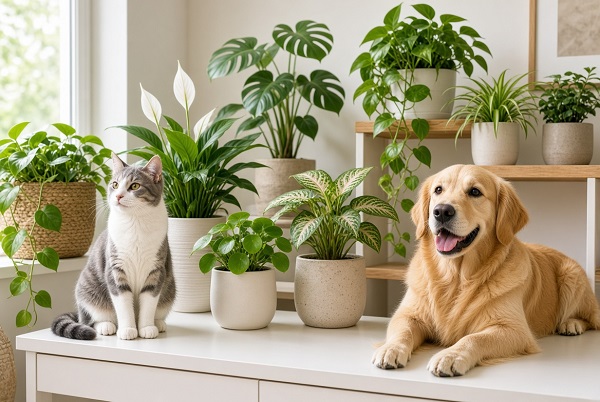
Want houseplants that won’t harm your pets? Here are 10 cat and dog safe plants, why they’re non-toxic, and easy care tips to keep them alive.
Some houseplants are genuinely safe if your cat or dog nibbles on them. Good picks include the spider plant, Boston fern, African violet, areca palm, calathea, phalaenopsis orchid, and air plants. These won’t poison your pet, and most are easy to keep alive too.
So you want a home full of green stuff. But you’ve also got a cat who treats every leaf like a personal salad bar, or a dog who chews first and thinks never. I get it. That’s a tricky combo.
The good news? You don’t have to pick between plants and pets. Plenty of popular houseplants are totally fine for animals, even if they take a bite or two. Below I’ve pulled together ten of them, with a bit on why they’re safe and how to actually keep them going.
Let’s get into it.
Why the plants you buy actually matter
Here’s a stat that surprised me. In 2024, the ASPCA Animal Poison Control Center handled more than 451,000 calls about pets getting into toxic stuff — that’s nearly 4% more than the year before. Plants and fungi made up 8.1% of those cases (ASPCA, 2025).
That’s not a small number. And a lot of the usual suspects are super common houseplants. Lilies, pothos, aloe, philodendron. People buy them all the time without knowing they’re a problem.
Cats are especially at risk. They’re curious, they climb, and they’ll chew on a dangling leaf just because it moves. Dogs tend to go for whatever’s on the floor. So the plant that’s safest is often the one that matches how your specific animal behaves.
Point is, checking before you buy is worth the two minutes. Now let’s talk about the plants you don’t have to stress about.
The plants you can actually relax about
Spider plant — the beginner’s best friend
If you buy one plant off this list, make it this one. The spider plant is certified pet-friendly by the ASPCA, and it’s almost impossible to kill.
It clears junk out of your air too, like formaldehyde and carbon monoxide. Care is easy: it handles pretty much any light level, so a dim corner or a bright window both work. Water it when the top soil feels dry and you’re done.
Boston fern — a bit of a diva, but worth it
Soft, feathery, and completely non-toxic. Cats love batting at the fronds and that’s fine, no harm done.
One thing though. Ferns like moisture. This one acts like a mini humidifier and can bump up the humidity around it by roughly 30%. Give it bright indirect light and a misting a couple times a week. Skip the misting and it’ll dry out and drop leaves. Ask me how I know.
African violet — small, fuzzy, always flowering
These stay compact, which is nice if you’re short on space. And they bloom pretty much year-round in pink, purple, or white. Safe for pets to sniff and touch.
Watering trick: don’t wet the fuzzy leaves or they’ll rot. Sit the pot in a shallow tray of water and let it drink from the bottom. Sounds fiddly. It’s not.
Areca palm — the big statement one
Want that lush, tropical, jungle-corner vibe? This is your plant. It can hit around six feet and the fronds are soft, so even if your dog gives one a chew there’s no risk.
Rotate it weekly so it grows evenly, and wipe the leaves now and then to keep dust off. That’s basically the whole job.
Calathea — the one everybody stops to look at
The leaves on these are wild. Stripes, patterns, deep purples on the underside. Non-toxic, and they’ve got this quirk where they release oxygen at night instead of during the day.
Downside? They’re thirsty for humidity, like 60% or more. A bathroom with indirect light suits them, or just park a humidifier nearby. If the edges go crispy and brown, that’s the plant telling you the air’s too dry.
Phalaenopsis orchid — fancy but forgiving
People assume orchids are hard. This one really isn’t. The blooms last three to six months, it’s happy in lower light, and it barely needs water.
Plant it in orchid bark, not regular soil. Water it well about every couple of weeks and let the roots dry out between. Petals and roots are both pet-safe, so no worries if your cat goes investigating.
Air plants — no soil, no digging
Tillandsia is kind of genius if you’ve got a digger. There’s no soil and no roots, so there’s nothing for a bored pet to make a mess with.
You can stick them on driftwood, hang them in little glass globes, whatever. Care is almost nothing: dunk them in water for about an hour once a month, give them bright indirect light, done.
Prayer plant — the one that moves
These fold their leaves up at night, like hands together, then open them again in the morning. Genuinely cool to watch. And they’re safe for cats and dogs.
They like it warm and humid and don’t want direct sun, which would fade those pretty patterns. Keep the soil lightly damp, not soggy.
Ponytail palm — the plant you’ll forget to water
Not really a palm, but whatever. It’s got this fat trunk that stores water and a burst of long curly leaves on top, kind of like a green fountain. Non-toxic and honestly hard to kill.
Because it hoards water in that trunk, you can basically ignore it for a while. Bright light, water only when the soil’s fully dry. Perfect if you travel or just forget things.
Money tree — good luck, no toxins
The braided trunk is the giveaway. Money trees are safe for pets and they’re supposed to bring good fortune, which, sure, why not.
Give it bright indirect light and water when the top inch of soil dries out. Too much water is the main way people kill these, so err on the drier side.
How to check a plant before you bring it home
Quick rule: if you’re not sure, look it up. Don’t guess.
The ASPCA keeps a free searchable list of toxic and non-toxic plants online, sorted by whether it affects cats, dogs, or both. Takes ten seconds to check a name.
A couple more things worth knowing:
- Common names lie. Loads of plants share names or get mislabeled at the store. Check the scientific name if you can.
- Safe doesn’t mean snack. A non-toxic plant won’t poison your pet, but a dog that eats a whole fern is still gonna throw up. Non-toxic just means it won’t do real damage.
- Every animal’s different. Some pets ignore plants completely. Others treat them as a buffet. Watch yours and plan around their habits.
Setting up a home where nobody gets hurt
Picking safe plants is step one. Where you put them matters just as much.
For cats, go up. Hanging planters and high shelves keep leaves out of reach, and air plants work great up there since there’s no soil to knock down. Cats climb, sure, but they’re less likely to bother a plant they have to work for.
For dogs, think about weight and placement. A heavy pot won’t tip when your dog bumps it. Floor-standing plants like the areca palm can double as a soft room divider near their bed. Just keep anything you’re less sure about off the floor entirely.
And keep the ASPCA poison control number somewhere handy — (888) 426-4435. Hopefully you never need it. But if your pet gets into something and you’re panicking at 2am, you’ll be glad it’s saved.
Where to start if you’re new to all this
Don’t overthink it. Grab a spider plant. It’s cheap, it’s tough, it’s safe, and it’ll survive while you figure out whether you’re actually into this whole plant-parent thing.
Once you’ve kept one alive for a month, add a second. Maybe a pothos-looking calathea for the pattern, or an orchid if you want a flower. Build slowly.
The whole point is a home that feels alive without you having to watch your pet like a hawk. That’s completely doable. Pick from the list above, double-check anything new against the ASPCA site, and you’re set.
Common questions about pet-safe plants
Are spider plants really safe for cats?
Yes. The spider plant is on the ASPCA’s non-toxic list for both cats and dogs. Some cats get a little buzzed off chewing the leaves, but it won’t hurt them.
What houseplants are most dangerous for pets?
Lilies are the big one, especially for cats — even a small amount can cause kidney failure. Pothos, philodendron, aloe, and sago palm are also common household plants that are toxic. Check any of these against the ASPCA list before buying.
Can dogs and cats get sick from plants that aren’t toxic?
They can, yeah. Eating a big pile of any plant can upset a stomach and cause vomiting. Non-toxic just means it won’t cause serious poisoning — it doesn’t make the plant a good snack.
How do I know for sure if a plant is safe?
Look it up on the ASPCA’s toxic and non-toxic plant database. Search by the plant’s name and it’ll tell you if it’s safe for cats, dogs, or both. Use the scientific name when you can, since common names get mixed up.
What should I do if my pet eats a toxic plant?
Call your vet or the ASPCA Animal Poison Control Center at (888) 426-4435 right away. Try to note which plant and how much, since that helps them figure out how worried to be.