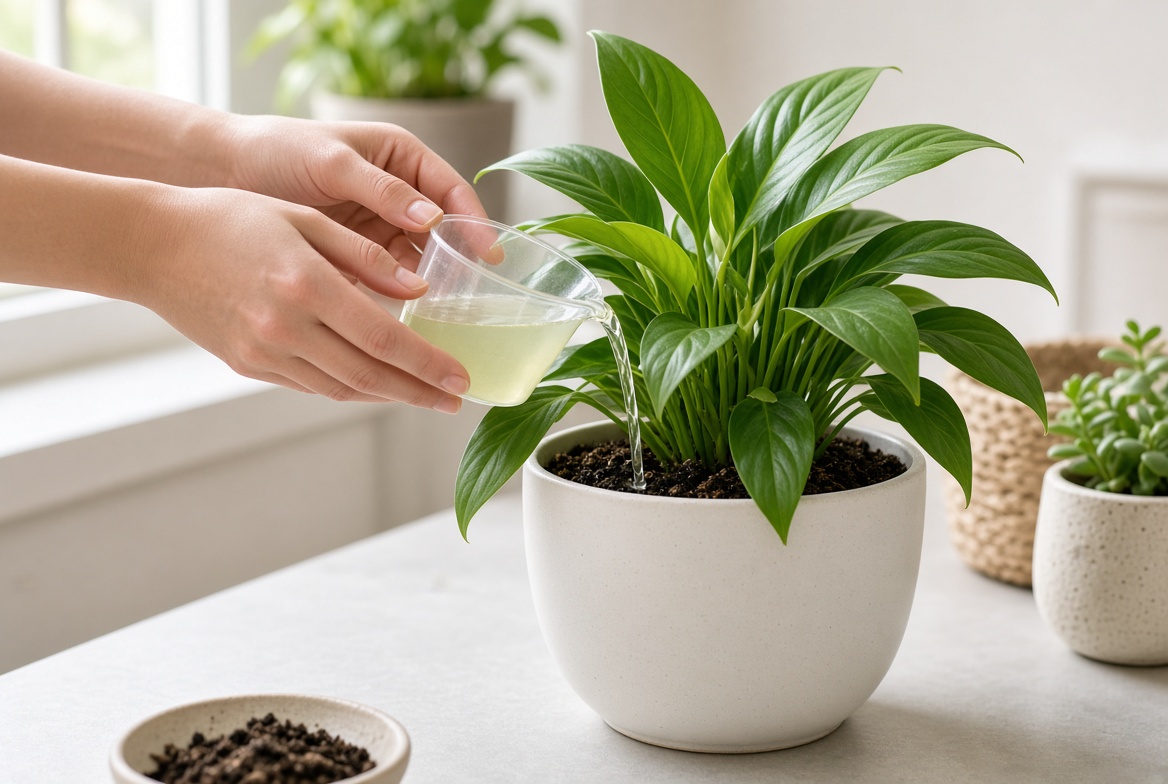
Houseplant fertilizer is useful when a plant is actively growing, but adding more doesn’t make a plant healthier faster. Fertilizers contain soluble nutrients, and when their concentration becomes too high around the roots, those salts interfere with the plant’s ability to take up water. The result can look surprisingly similar to drought stress even though the potting mix contains moisture.
Root damage from fertilizer is usually avoidable. The safest approach is to feed according to how actively the plant is growing, start with a mild concentration, apply fertilizer to a moist root zone, and occasionally allow plain water to wash accumulated salts through the pot.
The fertilizer bottle gives you a maximum application rate. It doesn’t know whether your pothos is growing rapidly beside a bright window or barely moving in a dim corner during winter.
Fertilizer Burn Is Mostly a Salt Problem
Most houseplant fertilizers supply nutrients in forms that dissolve in water. At suitable concentrations, roots can take those nutrients up and use them for new leaves, stems, and roots. Trouble starts when soluble salts accumulate faster than the plant can use them or watering can remove them.
A high salt concentration around roots makes water uptake more difficult. At sufficiently high levels, roots can lose water and become damaged. The leaves may then develop brown tips and margins, yellowing, wilting, or premature drop even though the original problem started below the soil.
You may also notice a white or pale crust forming on the surface of the potting mix, around the pot rim, or on the outside of an unglazed clay container. That deposit can be a clue that soluble salts have been accumulating.
It isn’t necessary to wait for visible crust before changing the feeding routine. Leaf damage and weak roots can occur before salt deposits become obvious.
Start Weaker Rather Than Stronger
A fertilizer label may provide a full-strength mixing rate, but many indoor plants don’t need that concentration at every feeding.
A safer starting point for actively growing houseplants is often around half of the labeled rate, unless the product instructions or the needs of a particular species say otherwise. Some plants are fed more lightly and more frequently, while slower-growing plants may need much less.
The concentration matters because doubling the fertilizer doesn’t double the benefit. Once the plant has enough nutrients for its current growth rate, increasing the amount mainly raises the amount of dissolved salts around the roots.
Never make a fertilizer mixture stronger than the product label recommends.
If you aren’t sure how heavily a plant needs feeding, starting mildly gives you room to adjust later. Recovering from a little underfeeding is usually much simpler than repairing a damaged root system.
Don’t Fertilize a Bone-Dry Root Ball
Applying soluble fertilizer to severely dry potting mix increases the risk of root injury because the roots are already short of water.
If the plant has become very dry, rehydrate the root ball with plain water first. Once the potting mix is evenly moist and excess water has drained away, fertilizer can be applied according to the product directions or at the concentration you normally use.
This matters most with liquid and water-soluble fertilizers, where nutrients become immediately available in the soil solution.
Don’t confuse moist soil with waterlogged soil, though. A plant sitting in saturated mix with unhealthy roots shouldn’t be fertilized simply because the soil is wet. Root problems need to be corrected before feeding becomes useful.
Feed Growth, Not the Calendar
A houseplant needs the most fertilizer when it is actually producing growth.
For many indoor plants, that period becomes more noticeable as daylight increases through spring and summer. Plants growing beneath strong grow lights may remain active for longer periods, while plants in weak natural light may slow considerably during winter.
This is why a rule such as “fertilize every two weeks all year” can cause trouble.
A Monstera producing large new leaves near a bright window can use more nutrients than the same plant sitting in weak winter light with almost no new growth. Continuing the same feeding rate while growth slows allows unused nutrients to remain in the potting mix, where salts can gradually accumulate.
Look at the plant before reaching for fertilizer. Fresh leaves, extending stems, active roots, and steady growth support feeding. A plant that has barely changed for several weeks generally needs less.
Low-Light Plants Usually Need Less Fertilizer
Light and fertilizer are closely connected because plants can’t turn extra nutrients into healthy growth if they don’t have enough light to support that growth.
This is one reason heavily fertilizing a plant in a dark corner rarely solves slow growth. The limiting factor may be light rather than nutrition.
Under weak light, extra fertilizer can remain unused in the growing medium and raise its salt concentration. You may end up with damaged roots while the plant continues growing slowly.
If a houseplant has become leggy, weak, or unusually slow, check its light before assuming it needs stronger feeding. Fertilizer supplies nutrients; it can’t compensate for a poor growing location.
Newly Repotted Plants Often Don’t Need Fertilizer Yet
Fresh commercial potting mixes frequently contain some fertilizer already, and a newly repotted plant has just had its root environment changed.
Adding another fertilizer dose immediately may be unnecessary.
Give the plant time to settle into the new mix and check whether the potting medium already contains fertilizer. For many ordinary repotting situations, waiting several weeks before beginning a regular feeding routine is a sensible approach.
This is particularly helpful when roots were heavily loosened, trimmed, or damaged during repotting. Freshly disturbed roots don’t benefit from being surrounded by an unnecessarily concentrated fertilizer solution.
If the potting mix contains a controlled-release fertilizer, take that into account before adding a separate liquid feed.
Also Read:
More Nitrogen Isn’t the Answer to Every Pale Leaf
Yellow leaves often send people toward the fertilizer bottle, but nutrient shortage is only one possible cause.
A plant can yellow because its soil remains wet, roots are damaged, light is weak, pests are feeding on the leaves, or an old leaf is naturally dying. Some nutrient problems do cause recognizable yellowing patterns, but leaf color alone isn’t enough to prove that fertilizer is missing.
Feeding a plant with unhealthy roots can make matters worse because those roots may already be struggling to absorb water and nutrients.
Before fertilizing a yellow plant, check the soil, roots, light, recent feeding history, and location of the yellowing. If several leaves turned yellow shortly after repeated fertilizer applications, adding another dose is unlikely to be the right response.
Liquid and Slow-Release Fertilizers Need Different Habits
Liquid and water-soluble fertilizers give you direct control over concentration. You dilute them in water and decide when the plant receives another application. That makes it easy to reduce feeding when growth slows.
Slow-release fertilizers work differently. Their coated granules release nutrients over a longer period, so you don’t need to mix fertilizer every few weeks.
Neither type is automatically safer if it is misused.
Problems can occur when someone adds liquid fertilizer to a pot that already contains an active slow-release product without accounting for the nutrients already present. The plant doesn’t recognize that the fertilizer came from two different products; it only experiences the resulting concentration around its roots.
Know what is already in the pot before adding more.
Plain Water Helps Keep Fertilizer Salts From Building Up
Container plants don’t receive natural rainfall washing through their soil the way outdoor plants often do. If small amounts of fertilizer are repeatedly added and very little water ever drains from the bottom, salts can accumulate in the potting mix.
Thorough watering helps limit this buildup.
When the plant needs water, apply enough plain water to wet the root ball and allow some excess to flow through the drainage holes. Empty the saucer afterward so the pot isn’t left sitting in the runoff.
Occasionally using plain water rather than fertilizer solution is especially useful for plants that receive regular liquid feeding.
If you already see salt deposits around the soil surface or pot rim, repeated thorough watering with plain water can help wash soluble salts out of a freely draining pot.
This only works properly when the container has drainage holes. Pouring a large amount of water into a closed decorative pot simply leaves the roots sitting in more water.
Brown Leaf Tips Can Be an Early Warning
Fertilizer injury doesn’t always begin with an obviously dying plant.
Brown tips or margins may appear first, followed by yellowing, wilting, leaf drop, or poor growth if root damage continues. Salt deposits around the pot can strengthen the suspicion, especially when the plant has been fertilized heavily or frequently.
Those symptoms aren’t exclusive to fertilizer burn. Dry air, inconsistent watering, root problems, and certain water-quality issues can produce similar leaf damage.
Recent care history helps separate them.
If a plant received repeated strong fertilizer applications shortly before its leaf margins began browning, fertilizer deserves attention. If it hasn’t been fed in six months, another cause is more believable.
What to Do If You Think You’ve Used Too Much Fertilizer
Stop feeding the plant and check the condition of the root zone before doing anything more aggressive.
If the pot has drainage holes and the roots aren’t sitting in badly waterlogged soil, flushing the potting mix with plenty of plain water can remove some accumulated soluble salts. Let the excess drain completely and empty the saucer.
Don’t immediately add a weaker dose of fertilizer afterward. Give the plant time to recover and watch the newer growth.
A plant with severe root damage may need closer inspection. Soft, dead, or badly deteriorated roots point to a more serious root problem than simple surface salt buildup.
Repotting isn’t automatically necessary after every fertilizer mistake. If the excess can be leached from a freely draining mix and the roots remain healthy, disturbing the plant may add stress without solving anything.
A Mild Feeding Routine Is Usually Enough
For many ordinary foliage houseplants, feeding during active growth at a modest concentration works better than trying to push constant rapid growth.
Start gently, especially with a plant whose previous fertilizer history is unknown. Make sure a dry plant receives plain water before fertilizer, and reduce feeding when growth slows because of weak light or seasonal changes.
Every few waterings, use plain water and allow some to run through the container. Keep an eye out for salt deposits and browned leaf margins, particularly if several fertilizer products are being used together.
Houseplants don’t need to be kept at the edge of their fertilizer tolerance to grow well. Give them enough nutrients to support the growth their light, roots, water, and temperature can actually sustain, and there is much less reason for fertilizer burn to occur.