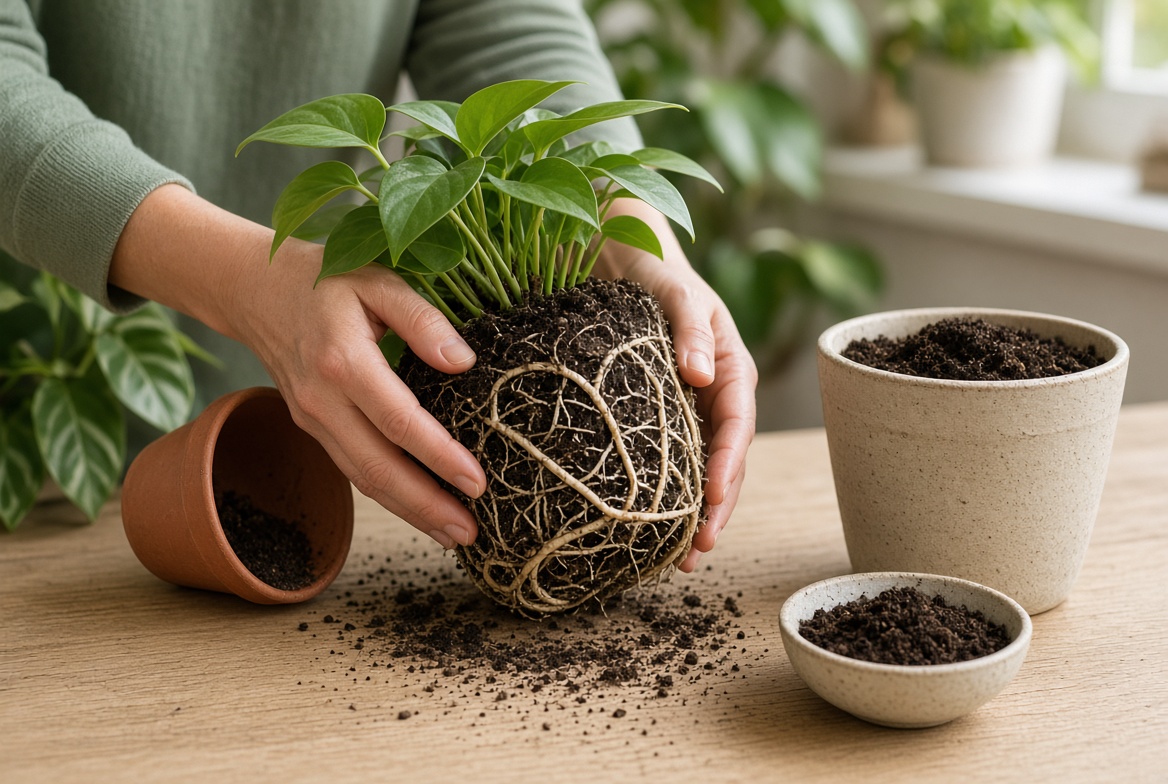
Repotting sounds like routine plant care, but a houseplant doesn’t automatically need a larger pot because a year has passed. Some plants fill their containers quickly, while others remain comfortable in the same pot for several years. A plant that is growing well, drying at a normal rate, and showing no signs of root crowding may be better left alone.
The more useful question is whether the roots and potting mix are still working well together. Once roots occupy most of the available space, water can move through the pot differently, the plant may dry much faster, and new growth can slow. Old potting mix can create a different problem by becoming compacted and holding water longer than it once did.
That means repotting isn’t always about giving a plant more space. Sometimes the plant needs a larger container, while in other cases it mainly needs fresh potting mix or attention to its roots.
Roots Coming Through the Drainage Holes Are a Strong Clue
Roots growing from the bottom of a nursery pot are one of the easiest signs to notice, but a few visible roots don’t always mean the plant is severely root-bound. Some roots simply find the drainage openings as they grow.
The stronger evidence appears when several signs occur together. Penn State recommends checking whether roots are circling densely around the root ball or whether so many roots fill the lower part of the pot that little potting mix remains visible. Illinois Extension also lists roots emerging from drainage holes or appearing at the soil surface among the signs that repotting may be needed.
If you aren’t sure, gently slide the plant from its pot and look at the outside of the root ball. A healthy established plant may have plenty of visible roots without being badly crowded. A tightly root-bound plant often has thick layers of roots following the shape of the container, sometimes wrapping around it repeatedly.
The difference matters because repotting an already comfortable plant into a much larger container doesn’t improve it simply because roots were visible.
The Pot Suddenly Dries Much Faster Than It Used To
A change in watering frequency can reveal root crowding before you ever look underneath the pot.
Imagine a plant that normally needs water every eight or nine days. Over several months, it begins drying after four or five days even though its light, temperature, and location haven’t changed. As the root system fills more of the container, there is less potting mix available to hold water, so the plant may become dry much sooner.
Penn State, Iowa State, and the University of Minnesota all list unusually fast drying as a sign that a houseplant may need repotting.
Fast drying isn’t proof by itself because warmer weather, brighter light, active growth, or a move into a sunnier room can produce the same change. Check the roots before assuming the pot is too small.
If the root ball is densely packed and water seems to rush through the container almost immediately, repotting becomes much more reasonable.
Also Read:
Water Can Start Running Straight Through a Root-Bound Pot
A badly root-bound plant sometimes becomes difficult to water properly.
The root mass can become so dense that water follows channels around the outside of the root ball instead of soaking evenly through it. University of Maryland Extension notes that water may pass through a pot-bound container too quickly, leaving the center of the root ball inadequately moistened.
This can create a frustrating pattern. You water the plant thoroughly, water appears in the saucer almost immediately, and yet the plant wilts again sooner than expected.
Check the center of the root ball before deciding that the plant simply needs more frequent watering. If the plant has become a dense mass of roots with very little potting mix left, increasing watering frequency may only be a temporary answer.
Smaller New Leaves Can Point Toward Crowded Roots
Root restriction can eventually affect growth above the soil.
Illinois Extension lists smaller-than-normal new leaves and wilting between normal waterings among the possible signs that a plant needs repotting. Penn State also recommends paying attention when foliage and stem growth slows despite otherwise reasonable care during the growing season.
Growth slowdown needs context because weak light, poor nutrition, temperature changes, pests, and normal seasonal slowing can produce similar symptoms. A plant growing slowly in winter isn’t automatically asking for another pot.
Root crowding becomes more convincing when small new leaves appear alongside fast drying, circling roots, or roots filling most of the container.
That combination tells you much more than leaf size alone.
A Top-Heavy Plant May Need More Than Extra Root Space
Sometimes the problem is mechanical rather than nutritional.
As foliage becomes larger and stems grow taller, a narrow nursery pot may no longer provide enough stability. The plant may tip easily or lean whenever it is moved. Iowa State and the University of Minnesota both mention top-heaviness as a reason to reassess the container.
A larger pot can help, but width and shape matter too. A tall plant doesn’t always need a dramatically deeper container; a broader, heavier pot may provide the stability it needs without surrounding the roots with a large volume of unnecessary wet soil.
This is particularly useful with tall foliage plants that have substantial top growth but relatively modest root systems.
Old Potting Mix Can Need Replacing Even When the Pot Size Is Fine
Not every repotting job requires a larger container.
Potting mix changes as it ages. Organic ingredients break down, particles become smaller, and the mixture can lose some of the air space it had when fresh. Iowa State notes that old potting soil may become compacted and poorly drained, while the University of Minnesota points out that some plants need fresh soil even when they don’t need a larger pot.
Watch for a container that suddenly takes much longer to dry, water that no longer absorbs normally, or soil that has collapsed into a dense mass. If the roots aren’t particularly crowded, refreshing the potting mix while keeping the plant in the same size container may make more sense than increasing pot size.
You can also replace the upper portion of potting mix on a plant that is otherwise happy and doesn’t need a full repot. University of Minnesota suggests refreshing the top inch or two in this situation.
Don’t Repot Just Because You Can See Roots
Roots at the soil surface sometimes worry new plant owners, but context matters.
Some species naturally develop visible roots near or above the potting mix, while others send roots through drainage holes long before becoming seriously crowded. A single root peeking from the bottom isn’t the same thing as a root ball made almost entirely of circling roots.
Before increasing pot size, slide the plant out and look at the whole root system.
If roots hold the shape of the container but there is still plenty of potting mix between them, the plant may have more time. If you can barely see the mix because the outside and bottom are wrapped in roots, repotting is much easier to justify.
Repotting should respond to what the plant is doing, not to one isolated root.
Some Houseplants Actually Prefer a Snug Pot
A slightly crowded root ball isn’t automatically unhealthy.
Iowa State notes that many houseplants prefer somewhat cramped conditions, which is another reason frequent repotting isn’t needed. Illinois guidance also points out that some plants perform well while pot-bound and may remain in the same container for years.
This doesn’t mean a plant should be left until roots have completely replaced the soil. It means there is no benefit in constantly moving a healthy plant into larger and larger containers.
Plants such as ZZ plants and many succulents are often quite comfortable in relatively snug pots. Faster-growing foliage plants may reach their limits sooner.
The plant’s growth habit matters more than an arbitrary repotting calendar.
Spring Is Convenient, but You Don’t Have to Wait for One Exact Date
Spring is often recommended because many houseplants begin more active growth as days become longer. New roots can move into fresh potting mix during a period when the plant is already growing vigorously.
Penn State calls spring the preferred time for this reason, while Illinois Extension recommends repotting during active growth, typically in spring or early summer. Iowa State says repotting can be done at any time but notes that late winter or early spring often gives good results.
That doesn’t mean a badly root-bound plant discovered in September must remain trapped until March.
If roots are severely crowded, the pot is breaking, the plant can’t be watered properly, or the existing soil has failed, repot when the plant needs it. Timing becomes more important when the repotting is optional rather than necessary.
How Much Bigger Should the New Pot Be?
This is where many well-intentioned repotting jobs go wrong.
A plant that has outgrown a six-inch pot doesn’t need a twelve-inch container simply because the larger pot will save another repot later. The extra potting mix holds water that the existing root system isn’t using, so the root zone may stay wet much longer than before.
Illinois Extension recommends moving up roughly one pot size, around one to two inches wider in diameter. Penn State gives similar advice, while the University of Minnesota recommends avoiding increases larger than about two to three inches in diameter.
For a typical houseplant, moving from a six-inch pot to an eight-inch pot is much more sensible than jumping directly to twelve inches.
Large mature plants don’t always follow the same exact numbers, but the idea remains the same: provide enough new space for root growth without burying a small root system in a huge volume of wet mix.
Why an Oversized Pot Can Stay Wet for So Long
Pot size changes the balance between roots and moisture.
When a small root ball sits inside a very large container, much of the surrounding soil contains no roots yet. Water remains in that soil until it evaporates or roots eventually grow into it, which can leave the central root zone wet for longer than the plant is accustomed to.
Illinois Extension warns that over-potting can keep soil wet too long and increase the risk of root problems. The same guidance recommends increasing container size gradually rather than making a large jump.
This is one reason a plant can suddenly begin yellowing after repotting even when the repotting itself was gentle. The owner keeps watering according to the old schedule, while the new container now takes much longer to dry.
Whenever pot volume increases, relearn the plant’s watering rhythm.
Choose a Pot With Somewhere for Excess Water to Go
A drainage hole makes repotting much easier to manage because excess water can leave the container instead of collecting beneath the roots.
Penn State, Iowa State, Illinois, and the University of Minnesota all recommend containers with drainage for ordinary houseplant culture.
If you like a decorative pot without a hole, you don’t necessarily need to drill it. Keep the plant in a slightly smaller nursery pot with proper drainage and place that inside the decorative container as a cachepot. Remove the inner pot for watering and empty any water that collects in the outer one.
This arrangement gives you the appearance of the decorative container without forcing the roots to live in trapped runoff.
Gravel at the Bottom Doesn’t Fix a Pot Without Drainage
Adding stones beneath the potting mix is an old recommendation that still appears in plant-care advice, but it doesn’t turn a closed container into a draining one.
The excess water still has no way to leave the pot. Iowa State specifically advises against putting gravel or rocks beneath the potting mix and notes that doing so can leave a wetter zone closer to the roots rather than improving drainage.
If drainage matters, create or use a drainage hole.
A layer of decorative stones underneath wet soil can’t perform the same job.
Use Potting Mix Rather Than Soil Dug From the Yard
Houseplant roots need a mixture that holds some moisture while still allowing air through the root zone.
Ordinary garden soil can become dense inside a container because it isn’t behaving under the same conditions it would in an outdoor bed. Illinois Extension recommends fresh potting mix for houseplants and advises using a mixture that drains well rather than heavy garden soil.
The exact mixture depends on the plant. A cactus and an African violet shouldn’t necessarily receive the same blend, and an orchid growing in bark is a different case again.
If the plant was growing well in its existing type of potting mix, choosing a similar fresh mixture is usually safer than suddenly placing it into something dramatically heavier or more water-retentive.
Watering Before Repotting Can Make the Root Ball Easier to Handle
A moderately hydrated plant is usually easier to work with than one whose root ball is bone dry.
Illinois Extension recommends watering before repotting so the plant is hydrated during the process.
You don’t need the pot dripping wet while you work. The aim is simply to avoid handling roots that are already severely dry and stressed.
A slightly moist root ball also tends to hold together better as the plant comes out of its container.
Getting a Stubborn Plant Out Without Pulling on the Stem
If a plant doesn’t slide out easily, pulling harder on the stem isn’t the safest answer.
Lay or tilt the pot and support the plant around its base. Flexible plastic pots can often be squeezed gently around the sides to loosen the root ball. With a rigid container, running a clean knife around the inside edge can help separate the roots and soil from the wall.
Iowa State recommends these methods for releasing stubborn root balls rather than forcing the plant out by its foliage or stems.
If roots have grown heavily through the drainage holes, you may need to loosen or trim those roots before the plant will come free.
Work slowly. Most repotting damage comes from unnecessary force rather than from the actual change of container.
What Should You Do With Circling Roots?
Once the plant is out, look at how the roots are arranged.
Roots that have followed the wall of the pot may continue circling if they are left in a tight mat. Illinois, Maryland, Penn State, and Iowa State all recommend loosening or dealing with densely circling roots during repotting.
With a mildly root-bound plant, gently teasing the outer roots apart by hand may be enough. A severely compacted root ball can require more intervention, including carefully cutting through portions of the outer root mat.
There is no reason to aggressively tear apart every root ball. A plant with loose, healthy roots and plenty of potting mix between them needs much less disturbance than one that has formed a solid root shell around the container.
Match the amount of root work to what you actually find.
Brown Roots Aren’t Automatically Rotten
Root color can be useful, but texture and condition matter more.
Many healthy roots are pale, cream, or tan, yet some plant species naturally have darker roots. A dark root isn’t automatically dead simply because it isn’t white.
Rotten roots tend to feel soft, limp, mushy, or easily separated, while healthy roots generally remain firm. Iowa State recommends removing limp, brown, or dead roots during repotting, but diagnosis should consider the plant rather than color alone.
If you find a few clearly dead roots, trim them with clean scissors. If most of the root system is soft and decayed, you are dealing with a root-health problem rather than an ordinary pot-size upgrade.
Keep the Plant at Roughly the Same Depth
Repotting isn’t an opportunity to bury the stem several inches deeper unless the particular plant has a reason to be planted that way.
Illinois Extension recommends setting houseplants at the same depth they occupied in the previous container.
Put enough fresh mix in the bottom of the new pot to position the root ball correctly, then fill around the sides. Leave some space between the surface of the mix and the rim so water can collect briefly rather than running over the edge as soon as you begin watering.
Firm the mix gently enough to support the plant, but don’t compress it into a hard mass. Roots need air spaces as well as moisture.
Water After Repotting, Then Relearn the Drying Time
For most ordinary repotting jobs, water the plant after it has been settled into fresh mix. This helps moisten the new material and settle it around the roots. Illinois, Iowa State, and Penn State all include watering as part of the repotting process.
After that first watering, don’t automatically return to the old schedule.
A larger pot containing fresh potting mix may dry at a very different rate from the crowded old container. Check the soil before watering again and learn the new pattern over the next few cycles.
This small adjustment prevents many post-repotting watering problems.
Don’t Rush to Fertilize a Freshly Repotted Plant
A newly repotted plant already has several changes to deal with: disturbed roots, new potting mix, different moisture behavior, and possibly a larger root zone.
Iowa State recommends waiting roughly two to four weeks before returning to regular fertilizer, noting that many fresh potting mixes already contain some fertilizer.
Adding a strong fertilizer dose immediately after root disturbance doesn’t help the plant establish faster and may add unnecessary salt around sensitive roots.
Let the plant settle first, particularly if substantial root loosening or pruning was needed.
A Few Droopy Leaves After Repotting Don’t Always Mean Failure
Some plants barely react to repotting, while others look unhappy for a short period afterward.
Disturbed roots can temporarily change how efficiently the plant takes up water. Illinois Extension notes that some plants may wilt or lose foliage after transplanting and then recover as roots establish in the new container.
Don’t respond to temporary drooping by repeatedly soaking the new pot. Check moisture first, just as you would with any other houseplant.
Also avoid moving the plant through several different locations while it adjusts unless its old location was clearly inappropriate. Keeping light and temperature reasonably stable removes extra variables.
Sometimes the Right Pot Is the Same Pot
Repotting and potting up aren’t identical.
If you want to keep a mature houseplant at roughly its current size, moving it into an increasingly large container may eventually become impractical. Penn State notes that a plant can be maintained at a similar size by reducing part of the root mass, refreshing the potting mix, and returning it to the existing container while balancing the top growth appropriately.
That kind of root pruning is more involved than an ordinary beginner repot, so it isn’t something every plant needs. It does show why “repot” shouldn’t automatically mean “buy a bigger pot.”
A large floor plant may need refreshed soil and root management without needing an even larger container.
Don’t Repot a Healthy Plant Just to Refresh Its Appearance
A new decorative pot can be tempting, particularly when the current nursery container looks plain. If the plant is growing well and the roots have plenty of room, you don’t need to disturb the root ball just for appearance.
Place the existing nursery pot inside a decorative cachepot instead.
This also makes future watering easier because you can remove the inner pot, water thoroughly, allow it to drain, and return it afterward.
Repot when something about the roots, potting mix, stability, or container is actually asking for attention.
Check These Signs Together Before Choosing a Bigger Pot
No single symptom is perfect, so the decision becomes easier when you combine several observations.
| What you notice | What it may tell you |
|---|---|
| Many roots coming through drainage holes | Roots may be filling the pot |
| Dense circling roots around the root ball | Strong sign of root crowding |
| Pot dries much faster than before | Roots may have displaced much of the soil |
| Water rushes through without soaking the center | Dense root ball or severely dry mix |
| Smaller new leaves with otherwise good care | Root restriction may be limiting growth |
| Plant tips over easily | Container may be too small or unstable |
| Soil stays wet unusually long | Old compacted mix or oversized pot may be involved |
| Potting mix has broken down and become dense | Fresh mix may be needed |
| One root appears through a drainage hole | Inspect further before repotting |
| Plant is growing normally and soil behaves normally | Repotting may not be needed yet |
The table works better as a diagnostic check than as a set of automatic rules. A plant that shows several signs together gives you much stronger evidence than one isolated symptom.
Before You Reach for the Biggest Pot on the Shelf
A houseplant usually tells you when its container has stopped working well. Roots crowd the edges, water begins behaving differently, growth slows, or the plant becomes unstable. Those changes matter more than whether the plant has spent six months, one year, or three years in the same pot.
If it truly needs more room, choose a container only modestly larger than the current one, make sure excess water can drain, and use fresh potting mix suited to the plant. Loosen tightly circling roots where necessary, keep the plant close to its previous planting depth, and water the new mix thoroughly.
Then pay attention to what happens next. The larger container will probably dry differently from the old one, which means the plant’s watering rhythm may change even if its location hasn’t.
Sometimes repotting gives a plant exactly the extra room it needs. Sometimes the better decision is fresh soil in the same pot, and sometimes the healthiest plant in the room is the one you decide not to disturb.