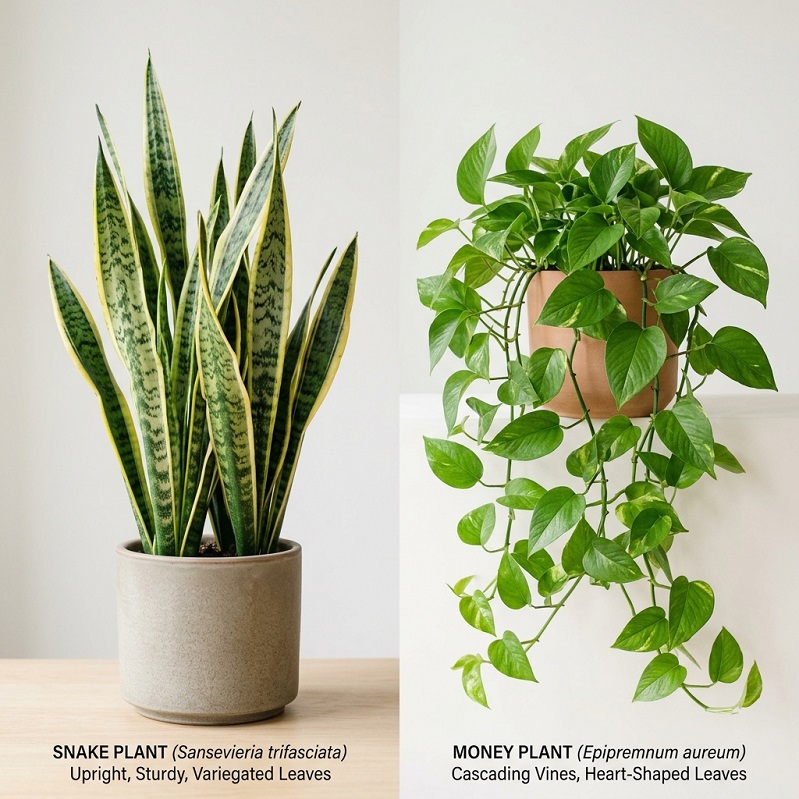
Compare snake plant and money plant side by side—care, watering, air purification, Feng Shui, and which one fits your home best.
Get a snake plant if you forget to water things and want something upright that pretty much runs itself. Get a money plant (pothos) if you like trailing vines, want easy cuttings, and don’t mind watering weekly. Both clean the air a bit and both are toxic to pets, so keep that in mind either way.
So you’re stuck between two of the most popular houseplants out there. I get it. They both show up on every “best beginner plant” list, they both look great, and people swear by each one. But they’re actually pretty different once you get past the surface. Let me walk you through what sets them apart so you can pick the one that fits your place and your habits.
What’s a snake plant, really?
The snake plant goes by a few names. Sansevieria is the old one, and a lot of growers still use it, though it’s technically been reclassified under Dracaena now. Some folks call it mother-in-law’s tongue, which is kind of funny once you see those tall, pointy leaves.
Here’s the thing most people miss. It’s a succulent, not a tropical plant. It comes from dry, rocky parts of West Africa, so it stores water right there in those thick upright leaves. That one fact explains basically everything about how you care for it.
It grows straight up. The leaves stand rigid and tall, and it barely takes up any floor space. If you want something structured and architectural for a corner or a shelf, this is your plant.
And the money plant?
When people say money plant, they usually mean pothos (Epipremnum aureum). You’ll also hear it called Devil’s Ivy or Golden Pothos. It’s earned the Devil’s Ivy nickname honestly, because it’s really hard to kill.
Instead of standing up, it trails. The vines spill down from shelves and hanging baskets, or you can train them up a moss pole if you want height instead. Heart-shaped leaves, lots of green, very forgiving.
It’s also one of the easiest plants to grow more of. Snip a cutting, stick it in water, wait a couple weeks, and you’ve got a new plant. Free plants. Who doesn’t love that.
How do they compare on care?
This is where the two really split.
Watering. The snake plant wants to dry out completely between drinks. In summer that’s about every 2 to 3 weeks. In winter you can stretch it to 4 to 6 weeks. Overwatering is the number one way people kill these things, so honestly, if you tend to neglect plants, this is a plus for you.
The money plant likes water more often, roughly once a week. It’s still forgiving. Miss a watering and it won’t hold a grudge. But it doesn’t have that same desert-plant tolerance for long dry spells.
Light. Both handle low light, which is why they’re on every beginner list. The snake plant does best in bright indirect light but survives dimmer spots, though its variegation fades and growth slows way down. The money plant is similar, happy in medium indirect light and fine in dim rooms too. Neither wants harsh direct midday sun.
Humidity. Different needs here. The snake plant is a low-humidity plant, no misting or pebble trays needed. The money plant actually prefers a bit more moisture in the air, and it gives some back too, releasing water into the room like it would in a rainforest. Nice little bonus in dry winter months.
Soil. Snake plants need fast-draining soil, a cactus or succulent mix works well. Money plants just want something well-draining, nothing fancy.
Here’s a quick side-by-side:
|
Snake Plant |
Money Plant (Pothos) |
|
|---|---|---|
|
Growth habit |
Upright, structural |
Trailing or climbing |
|
Watering |
Every 2–6 weeks |
About weekly |
|
Light |
Bright indirect, tolerates low |
Medium indirect, tolerates low |
|
Humidity |
Low, no fuss |
Prefers higher, adds some back |
|
Soil |
Fast-draining cactus mix |
Well-draining |
|
Propagation |
Slower (division or leaf) |
Very easy (water cuttings) |
|
Pet safe? |
No (saponins) |
No (calcium oxalate) |
Which one cleans the air better?
Both got famous partly because of NASA’s Clean Air Study. That research found the snake plant filters formaldehyde, benzene, and other common indoor pollutants. Pothos did the same, and one study even found Golden Pothos breaks down formaldehyde about 1.5 times faster than a Peace Lily.
Now, real talk. That NASA study ran in sealed lab conditions. To actually clean the air in a normal room, you’d need way more plants than most people own. So the practical effect is modest for both. Don’t buy either one thinking it’ll replace an air purifier.
The snake plant does have one genuinely cool trick, though. It uses something called CAM photosynthesis, which means it releases oxygen at night instead of during the day like most plants. That’s why people love putting one in the bedroom.
What about Feng Shui?
If that matters to you, the two plants carry different meanings.
The money plant is the wealth one. It symbolizes prosperity and positive energy, and the usual advice is to put it in the southeast or east corner of a room to draw in that abundance. Makes sense given the name.
The snake plant is more about protection. In Feng Shui it’s tied to fortune, longevity, health, and strength, and it’s often used as a front-of-house plant that guards the space. Worth noting some Feng Shui folks say to keep spiky, sharp-leaved plants out of the bedroom, which goes against the whole night-oxygen thing. So you’ll get mixed advice there.
One thing to know about pets
Neither of these is pet-safe. I don’t want to bury that.
Snake plants contain saponins, which cause nausea and vomiting in cats and dogs if they chew on them. Money plants have calcium oxalate crystals, which are worse in some ways, they can cause drooling, mouth swelling, and trouble breathing, and they’re toxic to people too if eaten.
If you’ve got curious cats or a dog that nibbles everything, keep either plant well out of reach, or look at a genuinely pet-safe option instead.
So which should you actually pick?
Here’s how I’d break it down.
Go with the snake plant if you kill plants by forgetting them, you want something upright for a corner, you like the idea of oxygen at night in the bedroom, or your home runs dry and you don’t want to fuss with humidity. It’s the more hands-off choice, full stop.
Go with the money plant if you love that trailing, cascading look, you’ve got shelves or hanging spots to fill, you want a plant that grows fast and makes propagation easy, or the wealth symbolism appeals to you. It’s a little more involved but rewards you with growth you can actually watch.
And honestly? There’s no rule saying you have to choose. They complement each other well. One stands tall, the other trails. Get both and call it a day.
FAQs
Which plant is better for beginners?
Both are beginner-friendly, but the snake plant edges it out if you’re forgetful. It goes weeks without water and shrugs off neglect. The money plant is nearly as tough but wants watering about once a week.
Can I keep a snake plant or money plant in the bedroom?
Yes. The snake plant is a popular bedroom pick because it releases oxygen at night. The money plant works too and helps with dry air. Just keep either one away from pets.
Are snake plants and money plants safe for cats and dogs?
No, neither is safe. Snake plants have saponins and money plants have calcium oxalate crystals. Both cause vomiting and irritation if a pet chews them, so keep them out of reach.
Which one is easier to propagate?
The money plant, by a mile. Cut a stem, put it in water, and roots show up in a couple weeks. Snake plants take longer and need division or leaf cuttings, and leaf cuttings from variegated types usually revert to plain green.
Do these plants really purify the air?
A little. NASA’s study showed both filter common pollutants, but you’d need a lot of plants to make a real dent in a normal room. Treat clean air as a small bonus, not the main reason to buy one.