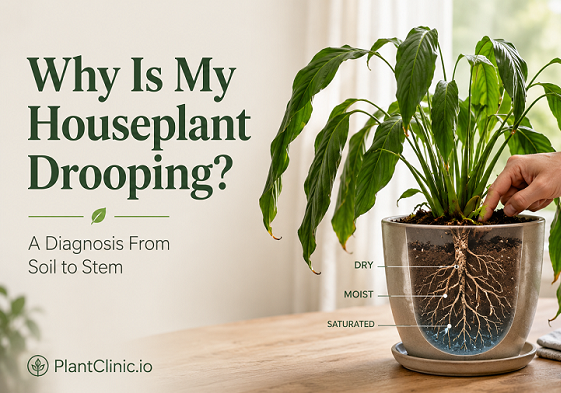
A drooping houseplant looks thirsty, which makes watering the obvious reaction. Sometimes that is exactly what the plant needs, but wilted leaves can also appear when the potting mix is too wet and the roots are no longer working properly.
That is why drooping is better treated as a symptom than a diagnosis. The leaves are telling you that they aren’t maintaining normal water pressure, but they aren’t telling you why. The cause may be dry soil, damaged roots, a badly root-bound pot, heat, cold, fertilizer injury, or a problem lower on the stem.
The quickest way to sort those possibilities is to start at the pot and work upward.
Check the Potting Mix Before You Add Water
The soil usually gives you more useful information than the leaves.
Push a finger into the mix rather than judging only the surface. If the root ball feels dry several centimeters down and the pot is noticeably light, lack of water becomes a reasonable explanation. If the mix is still wet and heavy, adding another watering may make the problem worse.
A badly dried pot can also fool you in another way. Peat-based mixes sometimes shrink away from the sides of the container after becoming very dry, allowing water to run around the root ball and straight out of the drainage holes. The plant appears to have been watered thoroughly, but the center of the pot may still be dry.
In that situation, apply water slowly in several passes or temporarily soak the container from below until the root ball has absorbed moisture again.
Dry Soil and Limp Leaves Usually Point Toward Drought
When there isn’t enough water around the roots, the plant cannot replace the moisture being lost through its foliage. Leaves lose firmness and begin to hang downward, while softer stems may also bend.
Drought stress often comes with other clues. The pot feels unusually light, the soil has pulled from the container wall, leaf edges may become dry, and older leaves can start yellowing if the condition continues.
Some plants react dramatically before serious damage occurs. Peace lilies are famous for collapsing when dry and then recovering after watering. Thick-leaved plants and succulents may show a slower response because they have more stored water.
If dry soil is clearly the problem, water the root ball thoroughly rather than giving a small splash to the surface. Let excess water leave through the drainage holes, then wait until the plant reaches its normal drying point before watering again.
Wet Soil Changes the Diagnosis Completely
A wilted plant sitting in wet potting mix deserves caution.
Roots need oxygen as well as water. When the mix remains saturated for long periods, air-filled spaces stay full of water and roots begin to function poorly. Continued saturation can kill roots and create conditions where root-rotting organisms can become established.
Once enough roots are damaged, the plant may wilt even though plenty of water remains in the pot. The roots simply aren’t able to move that water into the leaves properly.
This is the reason overwatered and underwatered plants can look surprisingly similar above the soil.
If the pot has remained wet for much longer than normal, check whether it has drainage holes, whether water is collecting in a decorative outer pot, and whether the potting mix has become dense and compacted.
When It Is Worth Looking at the Roots
One drooping afternoon doesn’t justify pulling every plant from its pot. Root inspection becomes more useful when the plant continues wilting despite wet soil or when yellowing, leaf loss, poor growth, or a sour smell appears at the same time.
Healthy roots vary in color between species, but they are generally firm. Roots affected by rot often become dark brown or black, soft, mushy, or easy to pull apart.
The amount of damage matters. A few dead roots can sometimes be trimmed away while the healthy portion of the root system is retained. A plant with extensive root loss is much harder to recover because it has very little functioning tissue left to supply the foliage.
If most of the roots are healthy, the problem may have more to do with watering frequency, drainage, or the condition of the potting mix than an established root disease.
A Root-Bound Plant Can Droop Even When You Water Regularly
A crowded root system creates almost the opposite watering problem.
When roots occupy most of the container, there is relatively little potting mix left to store moisture. The plant may dry much faster than it did several months earlier, which can lead to repeated wilting between otherwise normal waterings.
Roots may circle around the outside of the root ball, grow heavily through drainage holes, or form a dense mat at the bottom of the pot. The container can also feel unexpectedly light soon after watering.
Repotting into a container only modestly larger usually makes more sense than jumping into a huge pot. An oversized container introduces a large volume of wet soil around the same root system and can turn a fast-drying problem into a slow-drying one.
Heat Can Cause Temporary Afternoon Drooping
Not every wilt means the root zone has failed.
A plant near a hot window can lose water from its leaves faster than its roots can replace it, especially during strong afternoon sun. The foliage may droop temporarily even while the soil still contains reasonable moisture.
If the plant recovers as the room cools later in the day, heat and high transpiration deserve consideration before changing the watering schedule.
This pattern is more believable when the drooping appears during the hottest part of the day and the leaves recover by evening. A plant that remains limp through the night is more likely to have a deeper moisture or root problem.
Moving a sensitive plant slightly away from intense glass, especially during hot weather, may help without changing anything about the soil.
Sudden Cold Can Produce a Different Kind of Wilt
Tropical houseplants can also droop after exposure to cold air.
A plant next to an exterior door, cold window, or air-conditioning vent may experience temperatures far below the rest of the room. Chilling can damage cells and interfere with normal water movement, sometimes leaving foliage limp, darkened, or water-soaked.
The timing often provides the strongest clue. If the plant was healthy until it spent a cold night against window glass or was carried outdoors during freezing weather, temperature injury becomes more likely.
Watering more heavily won’t repair cold-damaged tissue, so check the recent environment before assuming that limp leaves indicate thirst.
Low Humidity Can Add to Water Stress
Dry indoor air increases the difference in moisture between a leaf and the surrounding atmosphere, which can increase water loss from the foliage.
For many ordinary houseplants, low humidity alone doesn’t cause an immediate dramatic collapse. It is more often part of a combination: warm air, bright light, dry potting mix, and low humidity together can push the plant toward wilt much faster.
Plants with thin leaves are often less forgiving than thick-leaved species.
Moving the plant away from heating vents can help because the problem there isn’t just low humidity; the leaves are also being exposed to moving warm air that encourages faster moisture loss.
Fertilizer Damage Can Leave a Plant Looking Thirsty
An overly strong fertilizer solution can injure roots and make water uptake more difficult.
The plant may wilt, develop yellow or brown foliage, or show scorched leaf margins. Salt deposits may also become visible as a pale crust on the potting mix or around the container.
This is another situation where adding more water needs some thought. If the soil isn’t already waterlogged and the pot drains freely, thorough watering with plain water can help wash accumulated soluble salts from the root zone. Fertilizer should be stopped until the plant recovers.
If the roots themselves have become badly damaged, the plant may continue drooping after the excess fertilizer is removed because root recovery takes time.
Look at the Stem if the Soil and Roots Don’t Explain It
Sometimes the problem is neither the leaves nor the roots.
Stem rot or a stem canker can interrupt the movement of water through the plant. University of Maryland lists stem cankers among possible causes of indoor-plant wilting and recommends looking for discolored areas on affected stems.
Pay particular attention near the soil line. A stem that has turned brown, black, soft, or collapsed at its base is more concerning than a healthy firm stem supporting drooping leaves.
With vining plants, damage to one section of stem may cause everything beyond that point to wilt while other stems remain healthy. That uneven pattern can help separate a localized stem problem from whole-pot drought.
Pests Can Cause Weak, Drooping Growth Too
Sap-feeding pests remove fluids from plant tissue and can weaken foliage enough to produce limp or wilted growth when populations become large.
Aphids tend to gather on tender shoots and buds, while spider mites often feed from the undersides of leaves and create fine pale stippling. Heavy mite infestations can also produce webbing. Mealybugs and scale may be easier to find around stems, veins, and leaf joints.
Pest-related drooping usually comes with evidence beyond the wilt itself. Sticky leaves, distorted young growth, pale speckling, webbing, cotton-like clusters, or visible insects make a pest diagnosis much more convincing.
Inspect the underside of the foliage before deciding that a weak plant simply needs more water.
Also read:
Repotting Can Cause Temporary Drooping
A plant may droop shortly after repotting even when the work was done correctly.
Roots are often disturbed during the process, and temporarily damaged fine roots may not absorb water as efficiently as they did before. The plant has also moved into fresh potting mix with a different moisture pattern.
Mild drooping after repotting doesn’t automatically mean you need to soak the pot repeatedly. Check the soil first and keep light and temperature reasonably stable while the roots settle.
More severe collapse deserves another look at what happened during repotting. Large amounts of root damage, a much-too-large new pot, compacted soil, or a drastic change in planting depth can create problems that go beyond ordinary transplant stress.
A Heavy Plant Can Droop Because the Stem Needs Support
Not every hanging stem is physiologically wilted.
Monsteras, philodendrons, climbing aroids, and other plants can develop long stems and large leaves that naturally begin leaning as they mature. A vine that has lost contact with its support may hang downward even though the leaves remain firm and hydrated.
Touch the foliage. True wilt usually changes the texture and firmness of the plant, while a mechanically unsupported stem can remain healthy and rigid despite leaning.
If the plant is a climber, a stake, trellis, or other suitable support may solve what looks at first like a watering problem.
Use the Recovery Time as Another Clue
How quickly a plant responds can help confirm what happened.
A mildly drought-stressed plant often begins regaining firmness within several hours after the root ball is thoroughly rewetted. The exact timing varies with species, temperature, root condition, and how severely the plant dried.
A plant with serious root damage usually doesn’t recover so cleanly because watering doesn’t restore the missing roots.
Temporary heat wilt may improve as temperature drops, while a cold-damaged or rotting plant may remain limp even after its environment changes.
Recovery isn’t a perfect diagnostic test, but it adds another piece to the pattern.
Read Drooping From the Pot Upward
When a houseplant starts hanging lower than normal, begin with the moisture around its roots rather than immediately reaching for the watering can.
If the root ball is dry and the pot is light, rehydrate it thoroughly and see whether the plant regains firmness. If the soil is wet, check drainage and consider root health before adding more water. A crowded root system, recent repotting, heat, cold, fertilizer salts, pests, or stem damage become more relevant when the moisture level doesn’t explain what you are seeing.
The most important distinction is simple: a drooping plant can be short of water inside its leaves without being short of water inside its pot.
Once those two conditions are separated, the diagnosis becomes much easier.