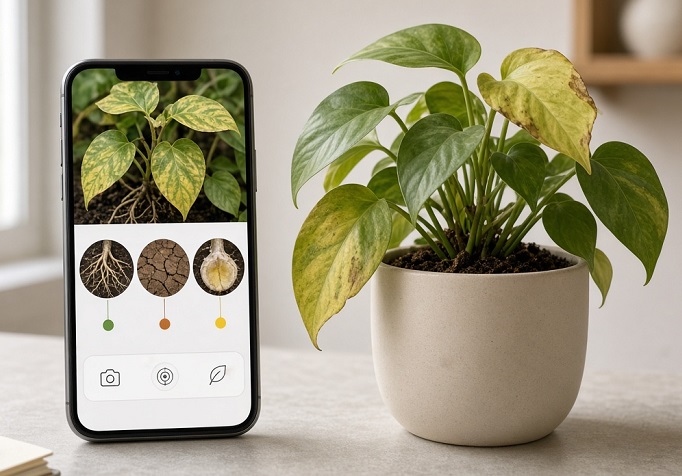
Take a photo of a wilted, yellowing houseplant and an AI plant app may confidently suggest underwatering. Another app may call it root rot, while a third recommends fertilizer. The frustrating part is that all three diagnoses can fit parts of what is visible in the photograph.
Plants have a limited number of ways to show stress. Leaves wilt, yellow, curl, develop brown edges, stop expanding, or fall. Those symptoms are useful clues, but they aren’t always specific to one cause.
A camera sees the result on the leaf. It usually cannot see how wet the middle of the root ball is, whether roots are firm or rotting, how often the plant was watered, what its potting-mix pH is, or whether the symptoms began on old leaves before spreading upward.
That missing information is exactly where root rot, drought stress, and nutrient problems begin to separate from one another.
A Wilted Leaf Doesn’t Tell You Whether the Soil Is Wet or Dry
Wilting seems like an obvious sign of thirst, but horticulturally it isn’t that simple.
A plant wilts when its leaves and stems aren’t receiving enough water to maintain normal pressure in their cells. Severe drought can cause that because there isn’t enough moisture available around the roots. A waterlogged plant can reach the same visible state for a different reason: damaged or dying roots are no longer able to supply the foliage properly.
Iowa State Extension specifically describes wilting as a symptom that can result from the opposite problems of underwatering and overwatering.
From a photograph, both plants may present the same broad signals. Leaves droop downward, older foliage begins yellowing, growth slows, and the plant looks generally weak.
The most useful clue may be inside the pot rather than on the leaf.
If the root ball is dry, light in weight, and pulling away from the pot, drought becomes much more plausible. If it remains saturated and the roots are dark, limp, or deteriorating, the diagnosis points elsewhere.
Unless an app asks for that information, the photograph alone cannot reliably make the distinction.
Root Rot Can Make a Plant Look Thirsty
Root rot is particularly awkward for image-based diagnosis because much of the important evidence is underground.
Penn State lists slowing growth, yellowing older leaves, wilting, dying leaf margins, and dark, limp roots among signs associated with root rot. It also warns that several of those above-ground symptoms can be caused by too much water, too little water, overfertilization, cold injury, or other root damage.
That creates a diagnostic trap.
The plant may look drought-stressed because water isn’t reaching its leaves properly, yet adding more water can worsen the conditions around already damaged roots.
A photograph of the foliage doesn’t reveal that contradiction. A useful root-rot diagnosis often requires at least some combination of soil-moisture history, drainage information, root inspection, odor, root texture, and knowledge of how quickly the pot has been drying.
The leaf is only showing the consequence.
Nutrient Problems Reuse Many of the Same Symptoms
Nutrient deficiencies don’t come with a single visual signature either.
General yellowing can be associated with low fertility, but Penn State’s diagnostic guidance also lists unsuitable light, high temperature, and a pot-bound root system among possible causes. Older yellow leaves can point toward deficiencies of nitrogen, magnesium, or potassium, yet the same pattern may occur with overwatering, root rot, root restriction, or simple leaf aging.
Young yellow leaves create another group of possibilities. Iron or manganese availability may be involved, but low light and excessive fertilizer can produce problems in similar parts of the plant.
Even interveinal chlorosis—the familiar pattern where tissue between the veins becomes yellow while the veins stay greener—needs context. Nutrients may be present in the potting mix but unavailable because the root-zone pH is unsuitable or because damaged roots are unable to function normally.
An image recognizer may correctly identify “chlorosis” while still getting the reason for that chlorosis wrong.
Root Problems Can Produce Nutrient-Like Leaves
There is another complication: these causes aren’t always independent.
Damaged roots don’t just interfere with water uptake. They also interfere with nutrient uptake.
Penn State notes that Phytophthora root rot can produce foliage with symptoms resembling nutrient deficiency, along with stunting, wilting, smaller leaves, and loss of feeder roots.
This means an app may see pale new growth and infer that the plant needs fertilizer, even though adding fertilizer does nothing to repair the failing root system.
From the plant’s perspective, there really may be a nutrient shortage in the leaves. The mistake is assuming that the shortage began because there wasn’t enough fertilizer in the pot.
Sometimes the nutrient is present but the roots can’t get it where it needs to go.
AI Is Usually Classifying Appearance, Not Proving Cause
Most image-based plant-diagnosis systems learn visual patterns from labeled photographs.
A model may learn that a certain combination of yellow patches, brown margins, spots, or distorted tissue frequently belongs to a particular label in its training data. That can work well when the new photograph resembles the examples it learned from.
The harder problem is causal diagnosis.
Two different stresses can produce similar visual patterns, and one stress can look different depending on species, severity, stage, lighting, or which part of the plant is photographed. A long-running review of automated plant-disease recognition identified visually similar symptoms, mixed problems, variable symptom appearance, background complexity, and uncontrolled image conditions as major obstacles to diagnosis from ordinary visible photographs.
More recent research still reports the same basic problem. Reviews published in 2025 and 2026 note that image models can perform impressively on controlled datasets yet lose reliability when images come from varied real-world conditions.
A convincing classification score therefore shouldn’t be confused with laboratory confirmation of what is happening inside a plant.
Training Photos Are Often Cleaner Than Your Living Room
Plant-disease datasets have historically included many carefully framed images where the affected leaf is obvious and the background is simple.
A real houseplant photograph may contain twelve overlapping leaves, shadows from window blinds, reflections, dust, variegation, old mechanical damage, and several symptoms at different stages.
Lighting alone can alter what an image model sees. Warm indoor bulbs can make a green leaf appear yellower. Strong sunlight can wash out pale areas, while shadows make healthy green tissue appear unusually dark.
Recent plant-disease AI research continues to identify uneven lighting, image noise, occlusion, complex backgrounds, and poor generalization outside training datasets as persistent problems.
Houseplant photos add another issue: the most diagnostic part of the plant may not be in the image at all.
A Leaf Photo Leaves Out the Plant’s History
Human plant diagnosis doesn’t normally begin and end with one photograph.
Penn State recommends looking at the identity of the plant, its growing conditions, care history, symptom distribution, and the entire plant rather than concentrating only on a damaged section.
For an indoor plant, useful questions include:
- How long has the soil remained wet?
- When was the plant last watered?
- Did the problem begin after repotting?
- Has light recently changed?
- Are the oldest leaves affected first?
- Is new growth yellow while old growth stays green?
- Does the pot have drainage holes?
- Have fertilizers recently been applied?
- Are roots firm or soft?
- Are there spider mites, scale insects, or fungus gnats?
- Did the plant recently move into colder conditions?
Those answers can change the diagnosis without changing the photograph.
A photo-first app that doesn’t gather this context is being asked to solve a much harder problem than it may appear.
One Plant Can Have More Than One Problem
Plant diagnosis becomes even less tidy when several stresses occur together.
A houseplant may be growing in low light and receiving too much water. The wet root zone begins damaging roots, while the weak light slows water use even further. Nutrient uptake declines and older foliage turns yellow.
Which single label should an image app choose?
“Overwatering” describes part of the situation. “Root rot” may describe another. “Low light” helped create the conditions, while the yellow leaf itself could resemble nutrient deficiency.
Iowa State warns that houseplant problems frequently involve several factors rather than one isolated cause. AI-diagnosis research raises the same issue, noting that multiple diseases, nutrient problems, and pests can occur in the same image rather than appearing as clean single-label cases.
That matters because many classification systems are naturally easier to train when each photograph has one correct answer.
Plants don’t always cooperate with that format.
Yellow Leaves Are Particularly Easy to Misread
Yellow is one of the weakest symptoms to diagnose without context because so many conditions can reduce chlorophyll or cause a plant to abandon damaged foliage.
Penn State’s current diagnostic key associates yellowing with low fertility, excessive or insufficient light, high temperature, pot-bound roots, overwatering, natural aging, root rot, and several nutrient shortages depending on where the yellowing begins.
Pests can add another possibility. Spider mites, scale, and other sap-feeding pests may create pale or yellow foliage while the insects themselves remain too small or too hidden to be obvious in a whole-plant photograph.
An AI app may notice the yellow color correctly. The difficult part is deciding why it appeared.
Brown Tips Aren’t Much Better
Brown leaf margins are sometimes presented online as if they have simple meanings: brown and crispy means underwatering, while yellow and soft means overwatering.
Real diagnosis isn’t that neat.
Penn State lists underwatering, overfertilization, pesticide injury, vascular problems, and root rot among possible causes of damaged leaf tips or margins. Other environmental stresses can produce similar damage.
Texture helps, but it still isn’t enough to make one symptom exclusive to one cause.
A brown margin on a plant whose soil has been dry for two weeks deserves a different interpretation from the same margin on a plant sitting in saturated mix with salt deposits around the pot.
The photograph may look almost identical.
The Pattern Across the Whole Plant Matters More Than One Damaged Leaf
A better diagnosis starts by asking where symptoms appeared first.
If older lower leaves yellow while young growth remains green, the suspect list differs from a plant whose newest leaves emerge pale. If only the side facing a hot window is damaged, excessive light becomes more believable. If every part of the plant wilts while the pot remains wet, the roots deserve attention.
This is why uploading a close-up of the ugliest leaf can sometimes make AI diagnosis harder rather than easier.
That leaf may contain good detail but poor context.
If an app allows several photographs, include the full plant, damaged and healthy foliage, the soil surface, the pot, stems near the soil line, and the roots when root trouble is reasonably suspected. A series of images gives the model more information than one dramatic leaf close-up.
AI Plant Apps Are Better at Suggestions Than Final Diagnoses
None of this makes plant-identification or plant-diagnosis apps useless.
Image recognition can be very good at narrowing a large list of possibilities, identifying obvious pests or characteristic diseases, recognizing plant species, and giving someone a starting point when they don’t know what to investigate.
The problem begins when a probable match is treated as proof.
Current AI research increasingly points toward systems that combine ordinary RGB images with other information, such as environmental data, sensors, spectral measurements, or additional contextual inputs, because photographs alone don’t capture every aspect of plant health.
A houseplant app that asks about soil moisture, light, watering history, fertilizer use, symptom progression, and root condition has a better diagnostic foundation than one that returns a definitive answer from a single leaf photograph.
Test the Diagnosis Before You Treat the Plant
The safest way to use an AI diagnosis is as a hypothesis.
If the app says underwatering, check whether the root ball is actually dry before soaking it.
If it says root rot, inspect the moisture history and roots instead of immediately cutting the root system apart.
If it says nutrient deficiency, look at which leaves are affected, consider root health and potting-mix pH, and review the plant’s fertilizer history before adding more nutrients.
If it says pest damage, examine the undersides of leaves and stems for the pest itself.
This small verification step matters because treatments for competing diagnoses can point in opposite directions. A drought-stressed plant may genuinely need water, while a plant wilting from badly damaged wet roots doesn’t need another soaking. A truly nutrient-starved plant may benefit from feeding, while a plant with fertilizer-salt damage needs the opposite response.
Also read:
Lantana vs Traditional Bedding Plants: Which Is Better for Your Garden?
The Missing Evidence Is Often Below the Leaf
AI plant apps tend to struggle with root rot, drought, and nutrient deficiency because those problems converge on a small group of visible symptoms while beginning through very different processes.
The leaf photo can show wilting, chlorosis, browning, or poor growth, but it may not reveal whether the soil is saturated, whether the roots are intact, whether nutrients are unavailable because of pH, or whether the plant has spent the last month in weak light.
That doesn’t make the image useless. It makes it one piece of evidence.
Use an AI plant app to generate possibilities, then check the physical conditions that separate those possibilities. Soil moisture, roots, symptom location, recent care, and the way the problem developed over time often tell you more about the cause than another close-up photograph of the same yellow leaf.